Rank and Rent: The Complete Guide for Operators
The rank and rent model end to end: how it works, the four-phase process, what the rent is worth by niche, done-for-you vs building it yourself, and scaling to a portfolio.

You build a website. You rank it for local service searches. Then you rent that ranked asset to a local business for monthly income.
That is the rank and rent model, and if you have spent any time around local SEO, you already know why it attracts so much attention. Local businesses need leads. Operators who can deliver them own something that pays every month.
The part most guides skip is the economics. Knowing that a plumber will pay for leads is easy. Knowing what a site with 25 qualified leads a month should rent for is what separates operators from hobbyists.
Here is the plan. This guide defines the model, walks the property lifecycle from niche selection through rental, breaks down the exact rent math, compares done-for-you options against building your own, and finishes with scaling and risk management.
Key takeaways
- Rank and rent operators build websites, rank them for local searches, then rent them to service businesses for monthly recurring income while keeping ownership of the asset.
- Working properties generate roughly 12 to 40 qualified monthly leads and rent for $300 to $1,800, anchored to documented lead volume and conversion rates.
- Platform-assisted building cuts site construction from weeks to days while keeping operator control, at a fraction of done-for-you services priced at $5,000 to $15,000.
- Operators scale by consolidating lead delivery, tracking, and reporting into one system across every property, since operations, not building, is what caps portfolio size.
- Market selection targets cities of 50,000 to 200,000 residents with job values above $200, urgent demand, and weak incumbent competition.
What rank and rent means
You build and rank a website for local service searches, then rent the site or its lead flow to a local business for a recurring monthly fee. The model treats your website as digital real estate. You construct the property, establish its location value through rankings, and collect rent from a tenant who needs the leads.
As the operator, you own the domain and maintain the rankings. You keep control of the asset even while a business pays for access to the leads it generates, and the asset stays yours through every renter change. For a neutral definition of the model, its pricing structures and the rules that apply to it, see What is rank and rent?.
Payment structures vary with the relationship:
- An exclusive monthly rental fee for the whole site
- Pay-per-qualified-lead arrangements
- Revenue-share agreements with local contractors
The lead value formula guides your pricing throughout this guide: qualified leads multiplied by close rate multiplied by contribution per job tells you what the site is worth to the renter, and the rent prices under that number.
Why the model works for both sides
Your renter, the local service business, gets immediate access to qualified leads without learning SEO, building a website, or waiting months for results. They usually pay less than their current ad channels charge them, and they focus entirely on the work while you handle rankings and delivery.

The intent behind these leads is what makes them worth paying for. Per 2026 local SEO research compiled by SeoProfy and WebFX, about 28% of local searches lead to a purchase, and roughly 76% of people who run a local search visit a business within 24 hours. A lead from a ranked local site is not a cold prospect. It is someone close to hiring.
A good rental market satisfies four conditions:
- Demand exists in the target city
- Current competitors are beatable
- Leads carry real value within the service radius
- The renter can handle more jobs without quality slipping
Your side of the deal is just as strong. You own the digital asset outright, so the website stays yours even if the renter walks away. You keep an income-producing property and find the next tenant. Each successful site adds another income stream, while the workload per property stays low.
The rank and rent process end to end
Four phases: select the niche and city, build the site, climb the rankings, and lease the ranked asset. Each phase has its own deeper guide; this is the connected walkthrough.
Pick the niche and city
Target cities between 50,000 and 200,000 residents where job values exceed roughly $200 and demand is urgent. Weak incumbent sites in these markets signal opportunity.
Beyond the obvious trades, promising under-the-radar niches include septic inspections, commercial hood cleaning, parking lot striping, mobile RV repair, and foundation crack repair, all high-value jobs with thin online competition in most cities.
Every market needs verification before you commit: local demand, competitor strength, margins, licensing requirements, seasonality, and whether enough candidate renters exist. The approach is evidence first, and the full criteria live in the niche selection guide.
Build the site
The asset needs service pages for each job type, location pages for geographic targeting, forms that send leads straight to an inbox, and clickable phone numbers on every page. Content depth is what wins: the site has to be the best local answer in its niche and city, not a brochure.
You face one early structural choice: a single-business service site rented to one contractor, or a directory listing many businesses that several pay to appear in. The site examples breakdown dissects four working archetypes page by page, and the domain strategy guide covers whether to register exact match, aged, or brandable before you build.
The build step has compressed most. Generating the site from a business factsheet turns weeks of construction into days, with lead capture and click tracking wired in from the start.
Rank it
Start with fast indexing so search engines find every page in days rather than weeks. Build internal links to establish topical authority, deepen coverage over time, and accumulate reviews wherever a business profile exists.
Then spend your hours where the ranking weight actually sits. Per ClickRank's 2026 Local SEO Ranking Factors analysis, local rankings break down roughly like this:
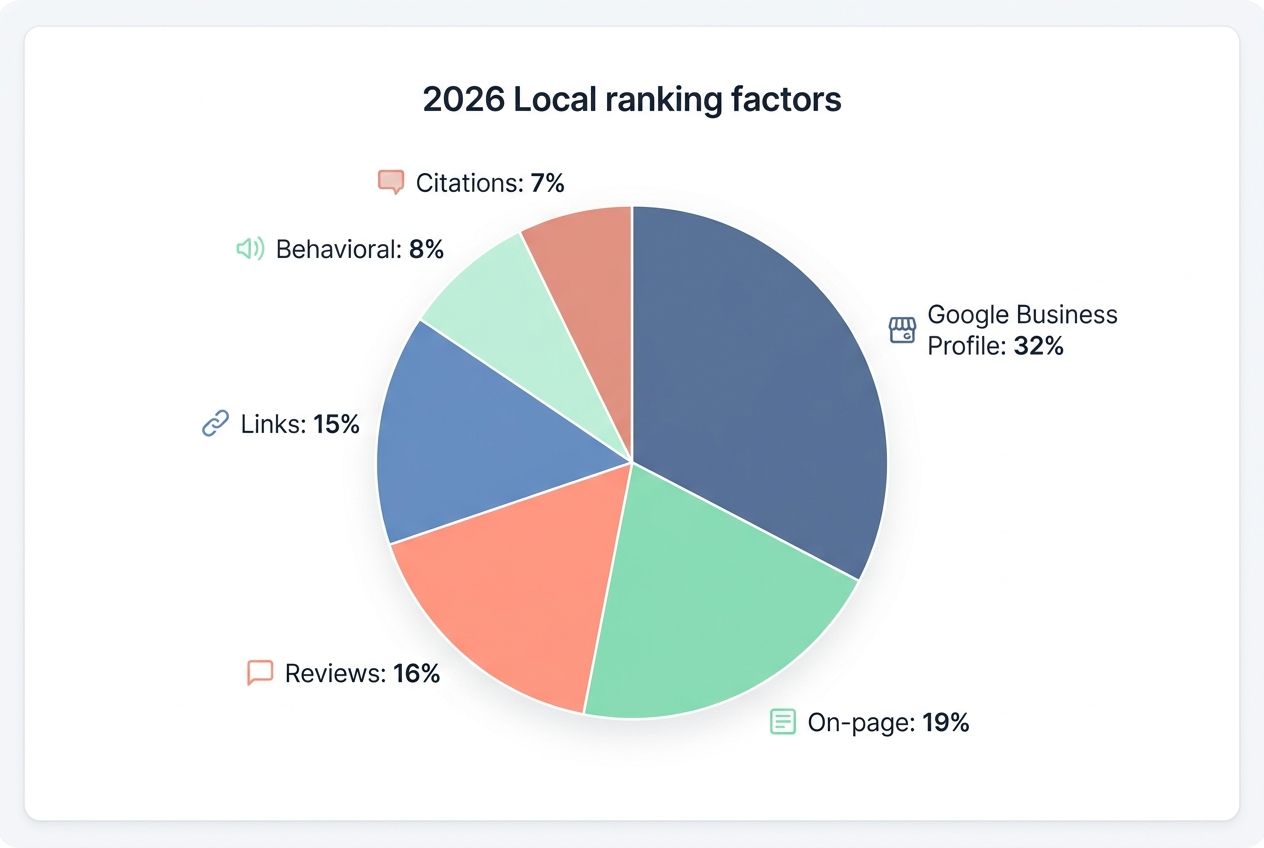
- Google Business Profile signals: 32%
- On-page signals: 19%
- Review signals: 16%
- Link signals: 15%
- Behavioral (8%) and citation (7%) signals
Read that as a priority list: profile activity and on-page content deserve most of your hours, not backlinks alone. One maintenance habit matters more than most operators expect: per the same 2026 reporting, profiles inactive for 30 or more days, with no new photos, posts, or review replies, show measurable drops in local impressions. Put profile activity on a monthly calendar for every property.
Structure the site so AI search engines can read and cite it, since assistants increasingly answer "who should I call" queries directly. Expect 3 to 6 months to rank in weak-competition niches, longer in contested markets.
Rent it
Start outreach before the site peaks. Target businesses already spending on ads, because they understand lead value and budget for acquisition. Offer two weeks of free leads as proof of quality: the trial removes their risk and creates urgency to convert.
Then structure the deal around documented lead volume. A basic test property with 12 qualified leads, a 20 percent close rate, and $250 contribution per job creates $600 in monthly value; charge $300 rent against $125 in direct costs and you clear $175 in gross margin. The full three-tier math is in the pricing section below.
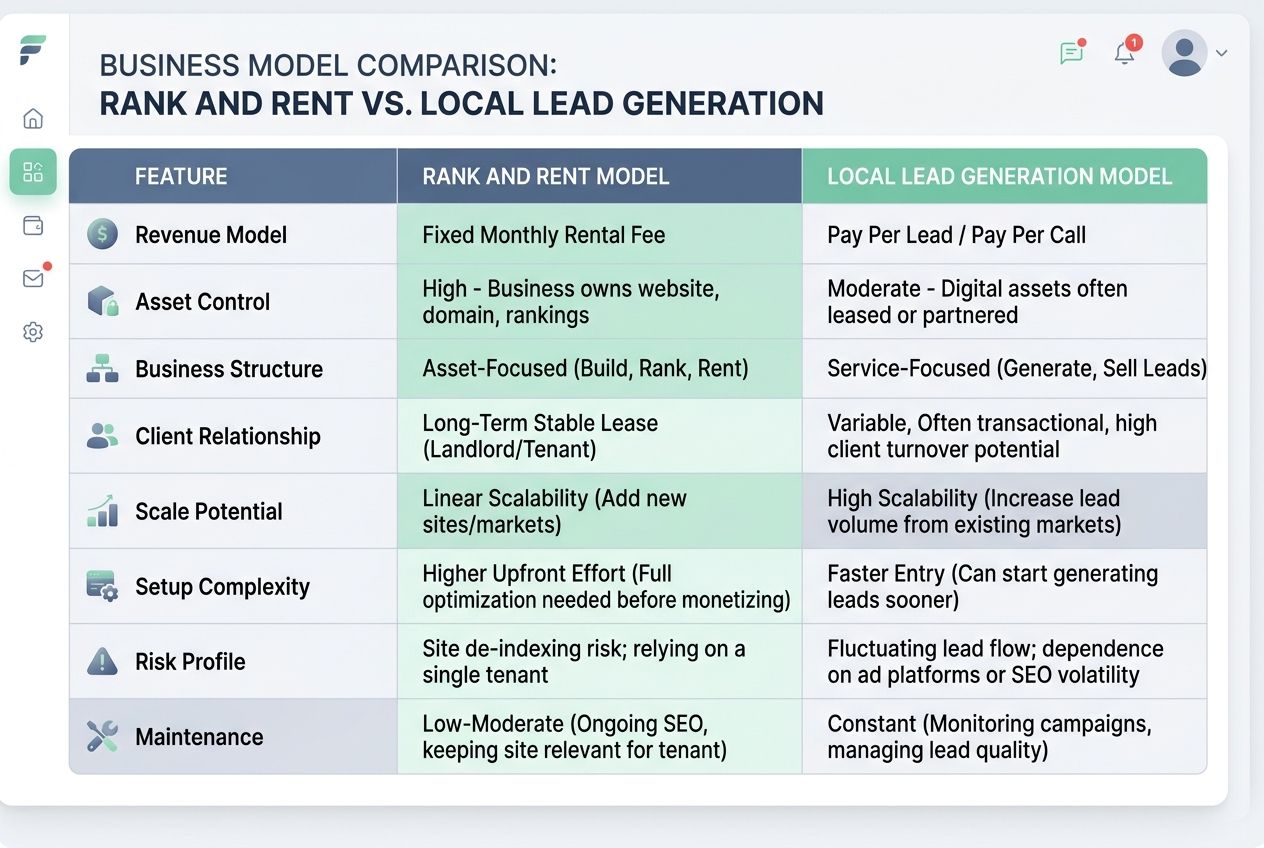
Rank and rent vs local lead generation: what's the difference
Rank and rent sits within the broader local lead generation category. Local lead generation is the umbrella business of capturing and selling local service inquiries; rank and rent specifically rents the whole ranked asset to one business, versus per-lead pricing or retainers on the same asset.
| Rank and rent | Broader lead generation | |
|---|---|---|
| Structure | One tenant rents the entire ranked site | Leads sold per-unit, possibly to several buyers |
| Revenue | Flat monthly rent, fully predictable | Scales with volume, varies month to month |
| Operator effort | Lowest once rented | Ongoing tracking and per-lead accounting |
| Upside | Renter captures growth in lead volume | Operator captures the upside |
| Proof burden | Lead history sets the rent | Every single lead must be tracked and defensible |
| Best when | Volume is unproven or steady | Volume is high and documented |
What the rent is worth
Rental income depends on the lead volume the site generates and what each lead is worth to the renter.
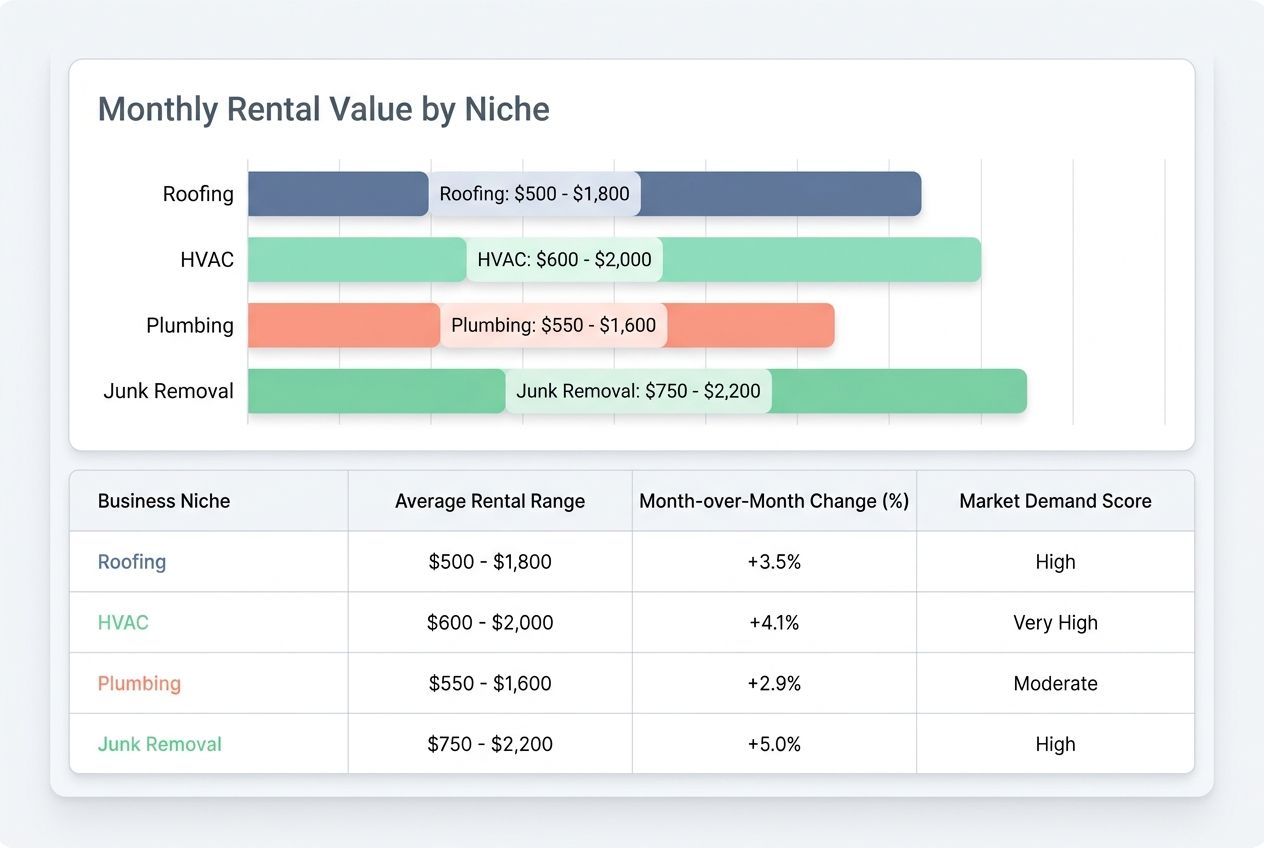
| Service niche | Monthly lead volume | Typical monthly rent | Pricing logic |
|---|---|---|---|
| Roofing | 15 to 45 leads | $500 to $1,800 | High job values support premium rents; roofing leads market at $75 to $160 each |
| HVAC | 20 to 50 leads | $600 to $2,000 | Seasonal demand; peak months support higher rates |
| Plumbing | 18 to 40 leads | $550 to $1,600 | Consistent year-round demand at $35 to $100 per lead |
| Junk removal | 25 to 60 leads | $750 to $2,200 | Lower per-lead values offset by volume |
| Landscaping | 30 to 70 leads | $900 to $2,500 | Spring and summer peaks drive valuations |
| Tree service | 12 to 35 leads | $400 to $1,500 | Emergency and storm work boosts lead value |
How pricing actually works
Rent anchors to documented monthly lead volume multiplied by a conservative per-lead value, priced just under the renter's current blended cost per acquisition.
External benchmarks back the logic. Per 2025-2026 benchmarking from SearchLight Digital and AgedLeadStore, average cost per lead runs roughly $105 for HVAC on Google Ads, and $55 to $183 for plumbing depending on the term. California, New York, Florida, and Texas run 20 to 50 percent above the national norm, so operators in those states can price rentals more aggressively.
This approach protects both parties: the renter saves against their existing channels, and you capture predictable revenue from an asset you own.
Real numbers from operating sites
Three property tiers show how the math scales:
- Lean test property: 12 qualified leads monthly at a 20 percent close rate and $250 per job creates $600 in renter value. Charge $300 rent, pay $125 in direct costs, keep $175 gross margin.
- Working property: 25 leads at a 25 percent close rate and $400 per job produces $2,500 in value. Rent of $900 minus $250 in costs leaves $650.
- Strong asset: 40 leads at a 30 percent close rate and $500 per job creates $6,000 in value. Rent of $1,800 minus $450 yields $1,350.
Tracked performance from 30 recently launched properties bears these ranges out. In the first full month, 8 properties produced 10 to 14 qualified leads and secured rents between $300 and $550. Another 14 generated 15 to 30 qualified leads and rented for $600 to $1,000. The remaining 8 delivered 31 to 45 qualified leads and attracted $1,100 to $1,900 in monthly rent.
Most first-month properties land in the 15 to 30 lead range, matching the mid-tier rent bands. Higher documented volume directly tracks with higher rent, so portfolio growth is about repeating the middle and upper tiers across markets.
Market rents for typical home-services sites run $500 to $3,000 monthly across niches. Conservative pricing attracts quality renters; aggressive pricing creates friction and churn. These examples are for planning only, exclude owner labor, taxes, refunds, and one-time build costs, and guarantee nothing.
Done for you vs build it yourself
Three build paths exist, each with a different time, money, and control profile.
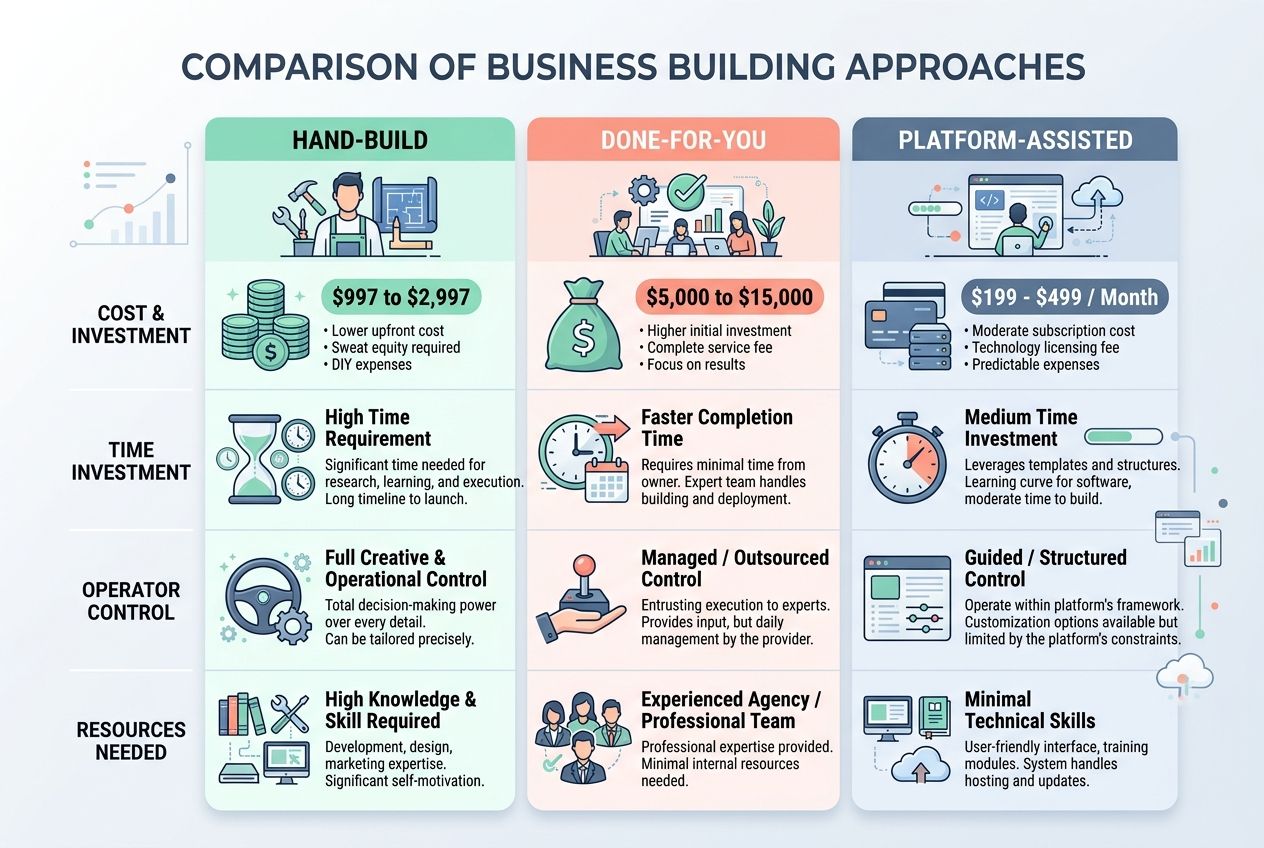
| Hand-build | Done-for-you | Platform-assisted | |
|---|---|---|---|
| Time | Weeks per site | Days to weeks, provider-dependent | Days per site |
| Cost | Low cash, high hours; courses charge $997 to $2,997 | $5,000 to $15,000 per ranked site | Moderate; build credits bundled in a subscription |
| Learning curve | Steep, and mistakes cost months | None, and you learn nothing | Manageable; platform handles the technical work |
| Control | Complete | Limited; you accept what is delivered | Full; you keep every decision |
A direct comparison of a single-city plumbing site in a 120,000-population market shows the gap. The hand-build baseline required 120 operator hours, roughly $1,400 in contractor and content costs, and 21 days to go live. The platform-assisted path took 18 hours, $220 in build credits, and 3 days. After 60 days, both properties captured comparable weekly lead volumes within a 10 percent margin.
Over 80 percent less operator time and roughly 85 percent less upfront spend for equivalent early lead capture, and the advantage multiplies as the portfolio grows.
Scaling from one site to a portfolio
Your first site teaches you the playbook. Your second site moves faster because you reuse everything that worked: the ranking blueprint, the content templates, the outreach scripts.
The real constraint at scale shifts from building to operations. Lead delivery, tracking, and reporting per renter is the bottleneck that caps portfolio size, and it compounds with every property you add.
Consolidating every site into one management system raises that ceiling: one dashboard for lead activity, CTA clicks, and city-level visitor data across the whole portfolio, replacing per-site spreadsheets. LocusPilot's tiers map to portfolio stages, from Operator at $29 monthly through Agency at $297 with larger build-credit bundles for operators running many properties.
Each new site adds revenue without a matching jump in workload. That is the core advantage separating operators who scale from those who plateau at one or two sites, and the portfolio economics article has the full numbers.
Risks and how operators manage them
Maintaining rankings and managing renters are the two ongoing jobs, and both carry real risks.
Algorithm risk is not hypothetical. Per Optra Marketing's 2026 analysis of Google's local search updates, a March 2026 core update specifically targeted thin content and businesses with weak online presence, and Google shipped three separate updates within a four-week window between February and April 2026, the highest local ranking volatility recorded that year. The lesson: invest in content depth, not shortcuts.
Legal exposure is knowable and manageable: lead-sale, referral, licensing, and consent rules vary by jurisdiction, and the legality guide covers what applies before you launch in any niche. Stay out of regulated trades like law and medicine until you have experience in simpler verticals.
What churn data shows
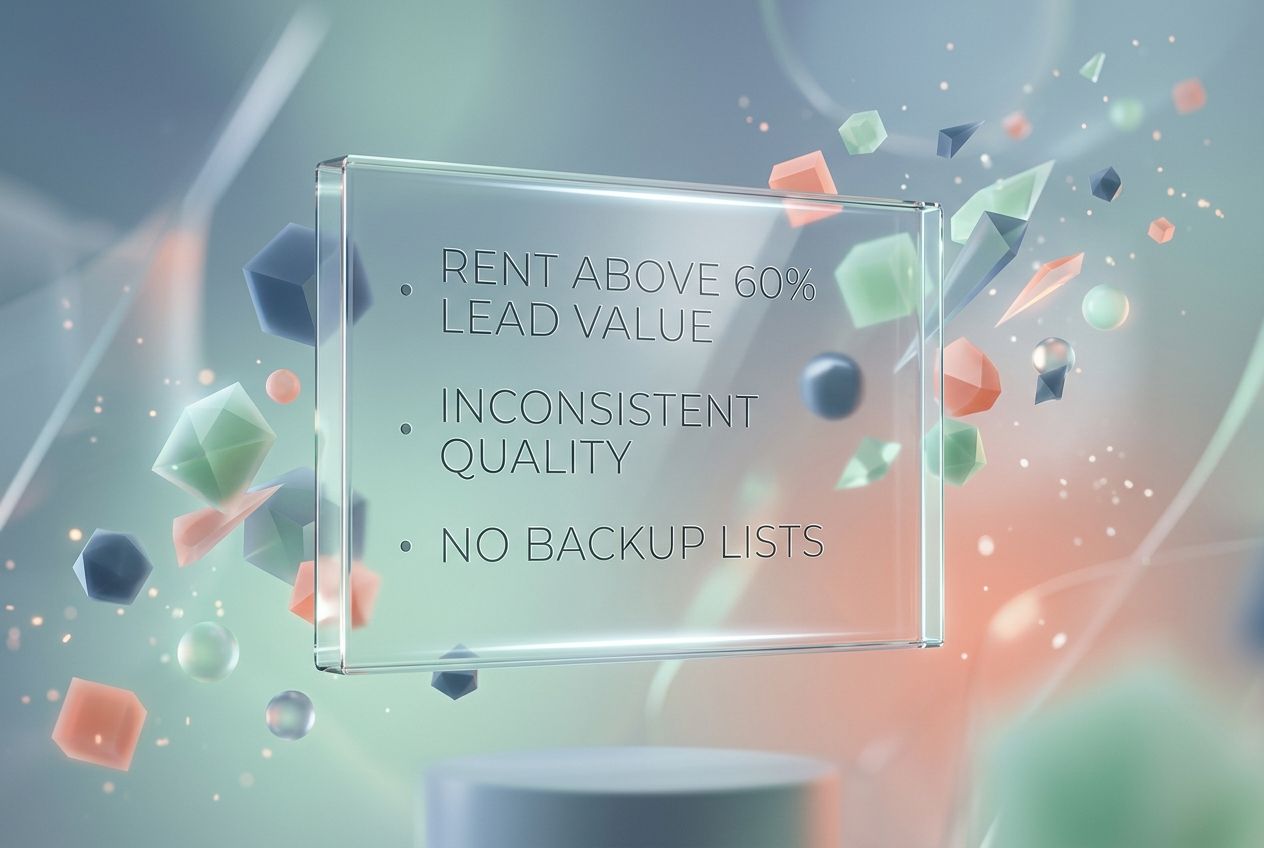
Analysis of three properties that lost renters within six months found the same mistakes repeating. Two priced monthly rent above 60 percent of documented lead value, which triggered churn right after the trial period ended. One delivered inconsistent lead quality because lead capture fields were misconfigured from launch. All three lacked backup renter lists, leaving the operators scrambling when the tenant canceled.
The fixes were simple: rent re-priced to 35 to 45 percent of documented lead value, capture rules corrected within 48 hours of discovery, and a three-name backup renter list built for every active property. Pricing and capture configuration drove most early churn, and the fixes restored rental stability.
The risk management playbook in one paragraph: pick weak-competition markets on evidence, build deep rather than thin, price conservatively against documented lead value, keep a backup renter list per site, and maintain delivery records both sides can see, so a renter exit is an administrative task instead of a crisis.
Conclusion
You build a website once, rank it with genuine depth, and rent it to a local business that needs the leads. The asset stays yours through every renter change.
The first concrete step is picking a niche where demand exists, competition is beatable, and leads carry real value: the niche selection guide walks the criteria. Then validate the city, and run the property lifecycle that turns a blank domain into a rental.
FAQs
What is rank and rent in one sentence?
You build a website, rank it in local search results, and lease it to a business that wants the leads, with established sites typically renting for $500 to $2,000 monthly depending on niche and documented lead volume.
Do I need to know SEO before starting?
You need the fundamentals: what makes a page rank locally, why depth beats thin content, and how indexing works. The deeper technical work is learnable as you go, and platform tooling now handles most of the mechanical parts, which moves the operator's real skill toward market selection and renter relationships.
Can AI tools speed up building rank and rent sites?
Substantially. Site generation from a business factsheet compresses the build from weeks to days, and AI drafting handles service-page volume. Treat generated output as a draft and edit for local accuracy, because both search engines and renters notice content that reads generic.
Is rank and rent better than e-commerce for a first online business?
It usually costs less to start, since you skip inventory, shipping, and refunds, and most operators launch a first site for under $500 plus their time. E-commerce can scale larger, but rank and rent produces recurring rental income from a single well-ranked site, and the asset appreciates while it pays.
Ready to build a rank-ready site?
Get 30+ pages, auto-applied images, and full SEO setup in minutes.
Get started