What is rank and rent? A plain-English explainer
Rank and rent is a lead generation model where an operator builds and ranks a local service website, then rents it or its enquiries to a business. How it works, how leads are priced, the rules that apply, and where it goes wrong.

Rank and rent is a form of online lead generation in which an operator builds a website aimed at local service searches, ranks it in search engines, and then rents the site or the enquiries it produces to a business that does the work. The operator keeps ownership of the domain and the rankings. The business pays a recurring fee, a price per lead, or a share of revenue for the customers the site sends it.
The name comes from the two halves of the job: rank the site, then rent it out. Other names for the same thing are lead generation website, lead-gen site, and, in the trade, "digital real estate", because the economics resemble a landlord letting a property to a tenant.
In brief
- What it is: a ranked local website whose enquiries are sold to a business.
- Who owns what: the operator owns the site and rankings; the tenant business gets the enquiries.
- How it is paid: flat monthly rent, a price per lead or per call, or a revenue share.
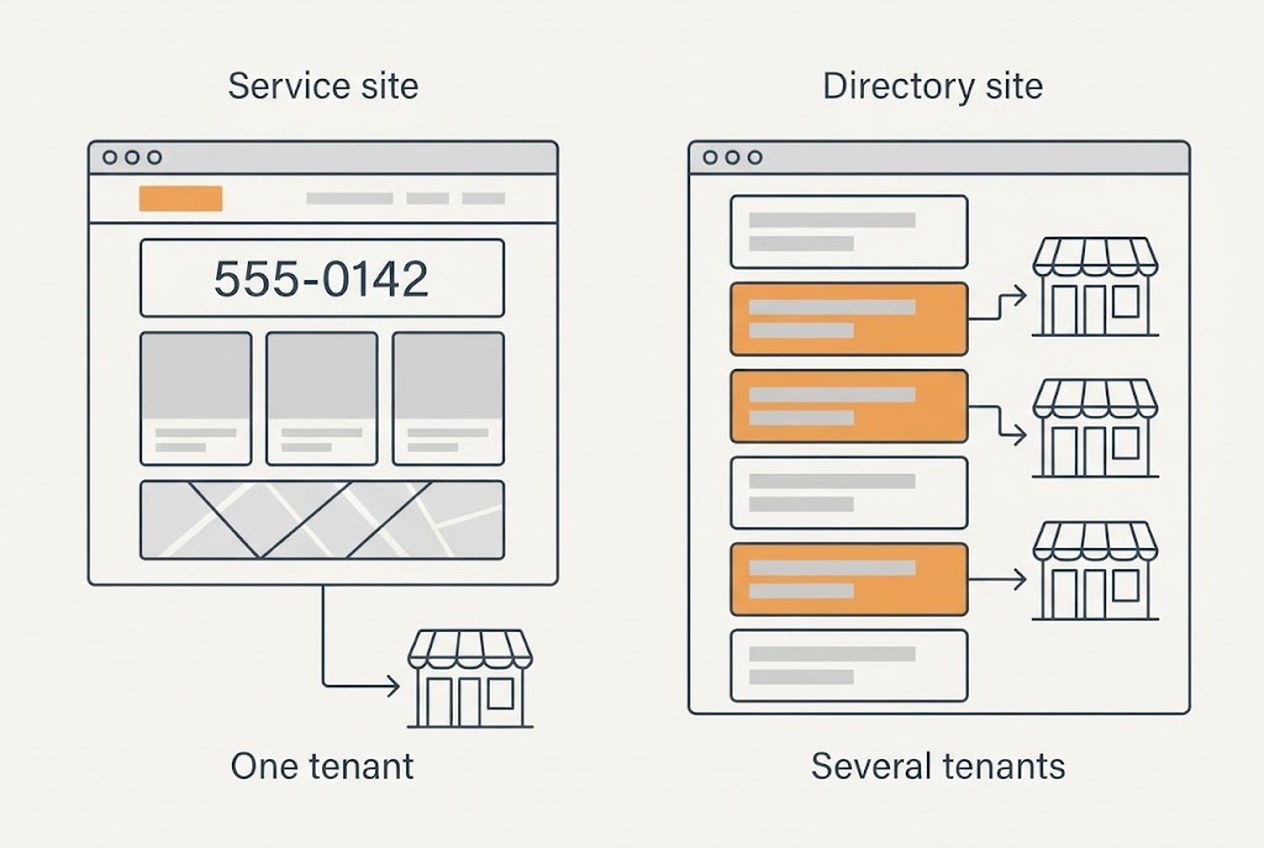
- Two forms: a single-provider service site, or a directory with several paying listings.
- What governs it: search engine spam policies, business listing rules, consumer protection law, and telemarketing consent rules.
- Where it fails: fake listings, fake reviews, impersonating a licensed business, and thin duplicate city sites.
This article describes the model as it is practised. It is a reference, not a how-to.
Where it sits in lead generation
Lead generation is the business of finding consumers who may want a product or service and passing their details to a seller. The US Federal Trade Commission defines it as "the process of identifying and cultivating individual consumers who are potentially interested in purchasing a product or service" (FTC staff perspective, 2016).
Most regulatory attention has gone to the large national verticals (payday lending, insurance, for-profit education), where leads are auctioned to many buyers through automated "ping trees". Rank and rent is the small, local end of the same industry: one service, one town, and usually one buyer.
It is close to two better-known models, and different from each in one respect:
- Pay-per-lead ad platforms such as Google's Local Services Ads also charge per enquiry ("Pay only for leads related to your business and the services you offer", per Google's Local Services help). The difference: a rank and rent operator owns the traffic source rather than renting it from a platform.
- Affiliate marketing pays a commission on completed sales. The difference: a rank and rent operator is usually paid for enquiries, not sales.
How does rank and rent work?
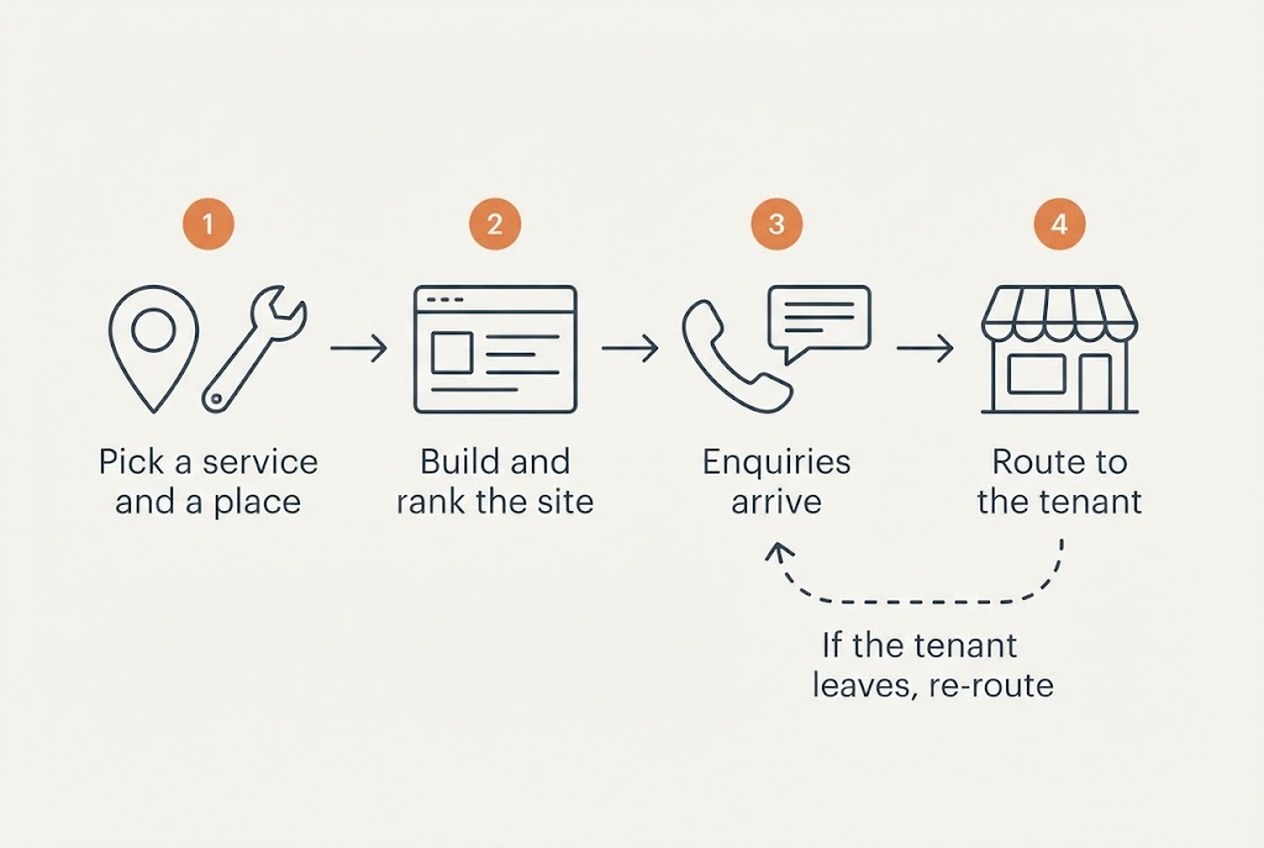
Rank and rent works in four steps: pick a service and a place, build and rank a website for it, collect the enquiries it produces, and route them to a business that pays for them. The sequence is the same in almost every account of the model:
- Pick a service and a place. One trade, one service area. Register a domain, often descriptive (a city plus a trade).
- Build and rank the site. Pages for the service, the areas covered, and how to get in touch, written to rank for queries such as "emergency plumber [city]".
- Enquiries arrive. By phone, form or messaging app, through a tracking number and a form that the operator controls.
- Route them to a tenant. The operator finds a business to receive the enquiries and forwards the number and the form submissions to it.
The site may stay neutral (a generic local provider) or be re-skinned with the tenant's name while the operator keeps the domain. If the tenant leaves, the operator points the enquiries at a new one. The site and its rankings stay with the operator throughout.
Two kinds of site
| Feature | Service site | Directory site |
|---|---|---|
| Presents as | A single local provider: one trade, one area, one phone number | A list of providers for a category and area |
| Tenants | One at a time | Several, each renting a listing |
| Enquiries | All go to the one tenant | Attributed to whichever listing the visitor chose |
| Strengths | Simple, easy to rank for one trade, the classic form | Spreads tenant risk, one site carries several incomes |
| Weaknesses | One tenant leaving means zero income until replaced | Harder to rank from a standing start |
How do rank and rent operators get paid?
Rank and rent operators are paid in one of four ways: a flat monthly rent, a price per lead, a price per call, or a share of revenue from the jobs the site produces. Four pricing structures cover nearly every arrangement in use.
| Structure | How it is priced | Typical use |
|---|---|---|
| Flat monthly rent | Fixed fee for exclusive access to all enquiries from the site | Established sites with a predictable lead flow |
| Pay per lead | A price per qualified enquiry, with rules for what counts (new customer, in the service area, for a covered service) | New sites, or tenants who want to pay for results only |
| Pay per call | A price per inbound call over a minimum duration, tracked through a forwarding number | Trades where the phone is the main channel, such as emergency work |
| Revenue share | A percentage of the value of jobs closed from the site's enquiries | Higher-ticket work, where both parties trust each other's reporting |
What a site rents for depends on what an enquiry is worth to the tenant: the trade's average job value, how many enquiries become jobs, and what the tenant would otherwise pay for the same lead through advertising. Those numbers vary by trade and city, so published figures for what a site "should" rent for are estimates. This article does not give any.
Who uses it and why
Operators are typically individual SEO practitioners or small agencies who would rather own a portfolio of ranking assets than sell services on retainer. The appeal is recurring income from an asset that survives the loss of any one client. Tenants are small local service businesses that want more enquiries without running their own marketing. For a business already buying leads from a platform, a rented site can be cheaper or more exclusive. For one with no website at all, it can be the only online presence it has.The arrangement works when three things are true: the enquiries are real, the tenant is a licensed business that can do the work, and both sides can see the same numbers.
What rules apply to rank and rent?
Rank and rent is not itself regulated, but the things a site does are. Four bodies of rules matter: search engine spam policies, business listing eligibility, consumer protection law, and telemarketing consent rules.
Search engine spam policies
Google's spam policies prohibit "doorway abuse", defined as pages "created to rank for specific, similar search queries" that "lead users to intermediate pages that aren't as useful as the final destination". One of Google's own examples is "multiple domain names or pages targeted at specific regions or cities that funnel users to one page".
The same document prohibits "scaled content abuse": "many pages generated for the primary purpose of manipulating search rankings and not helping users" (Google Search Essentials).
In practice: one useful site for one place is not a doorway. A network of near-identical city sites pointing at the same phone number is close to the textbook example, and operators who build that way risk losing the whole network to a single manual action.
Business listing eligibility
Google's Business Profile guidelines require that "a business must make in-person contact with customers during its stated hours", list "lead generation agents or companies" among ineligible businesses, and state that "only business owners or authorized representatives may verify and manage" a profile (Google Business Profile Help).
In practice: a rank and rent site cannot have its own map listing. The tenant's real business can, and the operator may manage it with the tenant's consent. A listing created for a site with no business behind it is a fake listing.
Consumer protection
The FTC's central concern with lead generation is transparency: "consumers who fill out web forms may not realize they are operated by lead generators and instead assume that they are submitting information directly to a merchant or other advertiser" (FTC, 2016).
In practice: a site that says plainly that enquiries go to a partner business, and names it where possible, is on the right side of this. A site that impersonates a specific business, or claims licences the tenant does not hold, is not.
Telemarketing consent
Where leads are followed up by automated calls or texts, the US Telephone Consumer Protection Act requires the consumer's prior express written consent. A stricter FCC "one-to-one consent" rule for lead generators was vacated by the Eleventh Circuit in January 2025 before it took effect; the underlying consent requirement remains (Morrison Foerster, 24 January 2025).
In practice: most rank and rent sites route enquiries to a human at the tenant business and are not affected. Any operator adding automated follow-up is.
Licensing in regulated trades is a fifth area and varies by jurisdiction. In some places, advertising a licensed trade under a name that does not hold the licence is itself an offence, whoever does the work.
Where does rank and rent go wrong?
Rank and rent goes wrong when the site stops being honest about what it is: fake business listings, fake reviews, impersonating a licensed business, or networks of thin duplicate city sites. One case shows most of them at once.
In June 2023 Google sued an operator who, according to the complaint, verified more than 350 Business Profiles for businesses that did not exist, posted around 14,000 fake reviews on them, and sold the listings and the consumer enquiries they generated to real businesses in plumbing, tree services, garage door repair and chiropractic.
Search Engine Journal, reporting the case, defined the practice for its readers as one "where someone will create a business website and an associated business profile for the purpose of selling leads from it, renting it to a business for a set price or selling the business profile and website" (Search Engine Journal, 19 June 2023; Search Engine Land).
The recurring failure modes, each a separate line that legitimate operators do not cross:
- Fake business listings for sites with no business behind them.
- Fake reviews bought to make those listings rank.
- Impersonation, where the site claims to be a specific licensed business it is not.
- Thin city networks, dozens of templated pages that add nothing a consumer needs.
- Tenants who cannot serve the area the site claims to cover.
- Orphaned sites that keep collecting enquiries after the tenant has gone and simply drop them.
The defensible version of the model is unremarkable: one real site, for one real place, that describes a real service accurately, passes enquiries to a licensed business that can do the work, and says so.
Related terms
| Term | Meaning |
|---|---|
| Lead generation website | Any site whose purpose is to collect enquiries for sale or referral; rank and rent sites are a subset |
| Pay per lead, pay per call | Pricing structures used by rank and rent operators and by advertising platforms alike |
| Local SEO | Ranking a site or listing for searches with local intent; the "rank" half of the model |
| Exact-match domain | A domain containing the target search phrase; historically favoured by operators, less influential than it once was |
| Digital real estate | Trade slang for ranking websites treated as income-producing property |
FAQs
Is rank and rent legal?
Building a website, ranking it and being paid by a business for the enquiries it sends is legal in the jurisdictions that publish guidance on it. The illegal or policy-breaking parts are the ones attached to some operations: fake business listings, fake reviews, impersonating a licensed business, and collecting consumer data without saying who receives it.
Does rank and rent still work?
The model still operates in 2026, and the constraints on it are clearer than they were: Google's spam policies name doorway and scaled-content abuse, its Business Profile rules exclude lead generation companies from having their own listing, and consumer protection and telemarketing rules apply to how enquiries are handled. Sites that are useful for one place and pass enquiries to a real licensed business are the ones that last.
How is rank and rent different from an agency retainer?
On a retainer, the client owns the website and the agency is paid for work. In rank and rent, the operator owns the website and is paid for results, and the site stays with the operator if the relationship ends.
How much does a rank and rent site rent for?
It depends on what an enquiry is worth to the tenant: the trade's average job value, how many enquiries turn into jobs, and what the tenant would otherwise pay for the same lead through advertising. Those figures vary by trade and city, so any single published number is an estimate. The usual structures are a flat monthly fee, a price per lead or per call, or a revenue share.
Is rank and rent the same as affiliate marketing?
No. Affiliate marketing pays a commission on completed sales, usually to a national merchant. Rank and rent pays for enquiries, usually from one local business, and the operator owns the website that produces them.
Does a rank and rent site have to tell visitors it passes enquiries on?
Regulators expect it to. The FTC's stated concern with lead generation is that consumers may not realise a form is operated by a lead generator rather than the business itself. A plain statement that enquiries go to a partner business, naming it where possible, addresses that.
Does a rank and rent site need a Google Business Profile?
The site itself is not eligible for one. Google's guidelines require in-person contact with customers and exclude lead generation companies. The tenant's real business is eligible, and the operator may manage that listing with the owner's consent.
References
- Federal Trade Commission, "Follow the Lead: An FTC Workshop on Lead Generation, Staff Perspective", September 2016. ftc.gov (PDF); press release, 15 September 2016.
- Google, "Spam policies for Google web search", Search Essentials. developers.google.com.
- Google, "Business eligibility and ownership guidelines", Business Profile Help. support.google.com.
- Google, "Getting started with Local Services Ads", Local Services Help. support.google.com.
- Roger Montti, "Google Sues Rank And Rent Marketer", Search Engine Journal, 19 June 2023. searchenginejournal.com.
- Search Engine Land, "Google files lawsuit over fake review scams", June 2023. searchengineland.com.
- Morrison Foerster, "Eleventh Circuit Vacates FCC's TCPA One-to-One Consent Rule", 24 January 2025. mofo.com.
About the author: Adam Yong has built and operated local lead generation websites in Malaysia and Singapore since the early 2010s and is the founder of LocusPilot, a site builder used by operators in this field. This article is a reference piece and does not describe any product.