Rank and Rent Website Examples: What Working Sites Actually Look Like
Four rank and rent site archetypes dissected: emergency, multi-service, multi-city, and directory, plus the page-by-page anatomy that working sites share.

You've researched rank and rent for weeks. You've read the theory. You know the three-step model: build, rank, rent.
Yet something still feels unclear. What does a working site actually look like? How many pages does it need?
Most operators studying this business model never see a real example taken apart.
A pattern repeats across audited sites: the difference between a site that rents for $1,500 a month and one that never rents at all is almost never the niche. It's the structure. Winning sites follow proven shapes that turn local searchers into logged, trackable leads.
Here's the plan. This guide walks through four site archetypes operators actively build and profit from, breaks down the page-by-page anatomy that separates converting sites from traffic traps, and finishes with the predictable mistakes that drain months of effort.
By the end, you'll be able to look at any local lead generation site and know within minutes whether it's built to earn.

Key takeaways
- Working rank and rent sites need dedicated service pages, location pages, contact forms, phone numbers, and call tracking that turns visits into measurable leads.
- Emergency service sites rent for $500 to $2,000 monthly on high-urgency call volume, while multi-service trade sites reach $1,000 to $2,000 through diversified lead flow.
- Multi-city portfolios and niche directories stack revenue streams, with directories charging $100 to $500 monthly per listed provider.
- Failing sites share predictable patterns: thin content, duplicate city pages, slow themes, no call tracking, and renting before rankings hold.
- The anatomy checklist applies to every archetype, so you can audit or plan any site in minutes.
What every working rank and rent site has in common
Every successful rank and rent website follows one core rule: it converts local searchers into trackable leads. Everything else is decoration.
The baseline every working site shares:
- A dedicated service page for each job type the niche offers
- Location pages covering every service area you target
- A contact form plus a clickable phone number on every single page
- Trust-building content that makes the site the obvious local answer
- Lead capture and tracking that logs every inquiry

That last item deserves a real budget line, not a vague mention. Per 2026 call tracking comparisons from AvidTrak and industry pricing roundups, CallRail plans start around $45 per month for organic call attribution, while newer entrants like CallScaler price local tracking numbers as low as $0.50 per number versus the roughly $3 industry standard. Tracking is how you prove to a renter that the asset delivers, so know the cost before the first site earns a dollar.
The design goal stays simple and non-negotiable: every element on every page serves lead generation. On-page optimization, NAP consistency across all pages, and internal linking that guides visitors toward one action, contact.
Example 1: the emergency service site
An emergency service site targets people facing urgent problems right now: emergency plumbing, water damage restoration, or 24/7 towing, in one mid-size city.
How the site is built
The structure stays lean on purpose:
- A homepage that doubles as the main service page
- Five to eight job-specific service pages for problems like burst pipes or flooded basements
- Three to five nearby-town pages that capture surrounding markets
- A phone number displayed everywhere, since emergency searchers call rather than fill out forms
Speed and clarity come first because visitors arrive in crisis mode, and the data backs this up hard. Per Google's Chrome User Experience data and mobile speed research cited by Lucky Orange and Amra & Elma, a one-second delay in mobile load time can cut conversions by up to 7 percent, and 53 percent of users abandon mobile sites that take longer than 3 seconds. For an emergency niche, that's not a UX preference. That's lost phone calls.
Service pages target high-intent phrases like "emergency plumber near me" and "24/7 water heater repair", the urgent queries that generate dozens of qualified calls a month.
The rent model and real numbers
Emergency sites price at a premium because every lead is an urgent, high-value job. The renter pays a flat monthly fee of $500 to $2,000 depending on call volume, with one exclusive renter per site. These niches also rank faster in small and mid-size cities thanks to lower competition, with seasonal spikes like frozen pipes driving winter call volume.
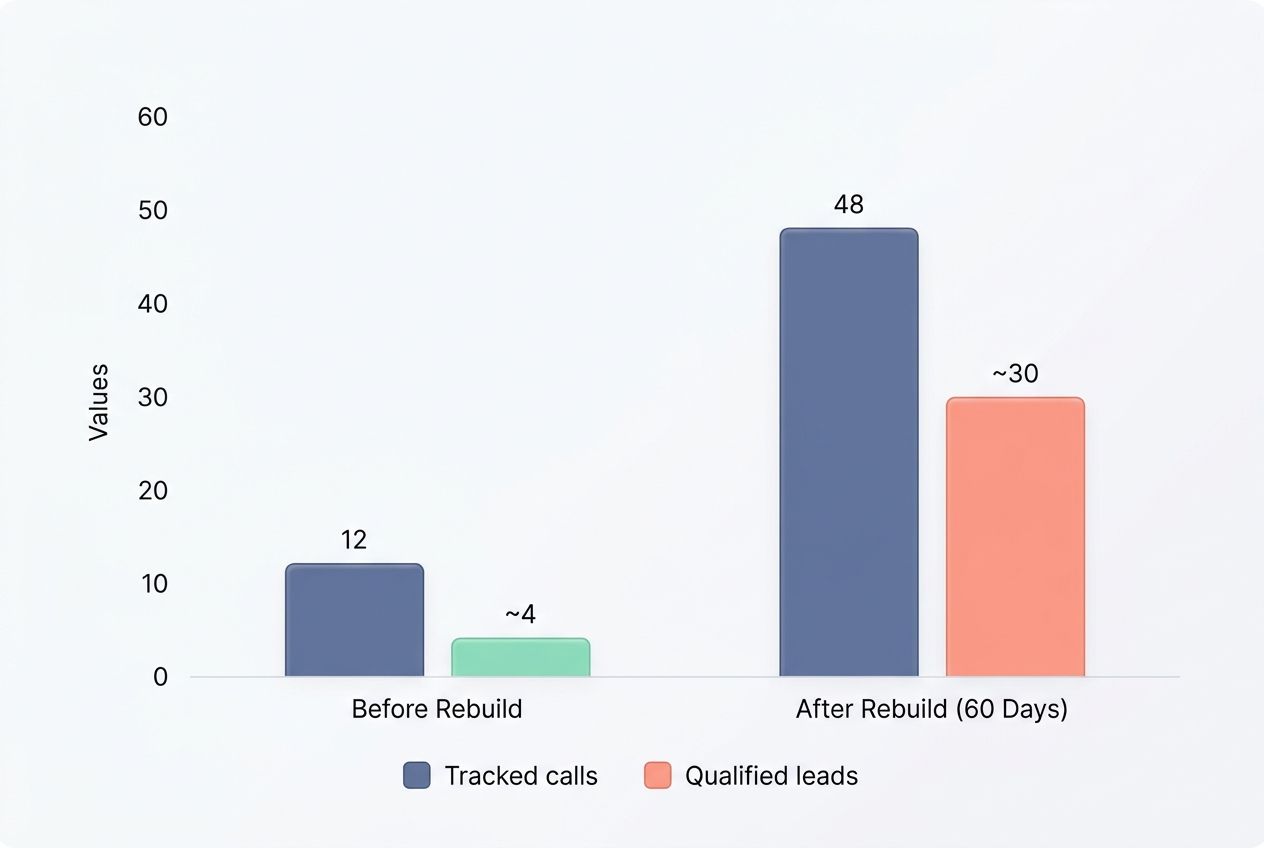
One emergency plumbing site targeting a mid-size Midwest city shows what the structure is worth. The operator initially launched with a prominent phone number but minimal service pages: 12 tracked calls a month, roughly 4 qualified leads, no attribution. After rebuilding to match the archetype, with five job-specific service pages, call tracking, and page speed work, the site logged 48 tracked calls and roughly 30 qualified leads within 60 days, with 75 percent of leads traced to organic location pages. Tracked call volume grew 4x in two months, and the operator stopped guessing where leads came from.
The site reads fast, direct, and phone-first, because that matches the visitor's mental state during an emergency.
Example 2: the multi-service trade site
This archetype covers several related services within a single market: an HVAC site spanning repair, installation, and maintenance across residential and light commercial.
You structure it with 10 to 20 service pages forming topic clusters, each targeting a specific service-and-location combination, so the installation page and the repair page rank separately. Seasonal content and FAQ pages build depth across the domain, since coverage breadth is what wins rankings in this archetype. Content depth settings control exactly this lever at build time.
A single renter offering multiple trades pays $1,000 to $2,000 monthly for the lead volume. Here's why that's an easy pitch. Based on SearchLight Digital's 2026 analysis of $14.9 million in contractor ad spend and Front Range Momentum's Q1 2026 benchmarks, the average Google Ads cost per lead for HVAC and plumbing sits around $104 nationally.
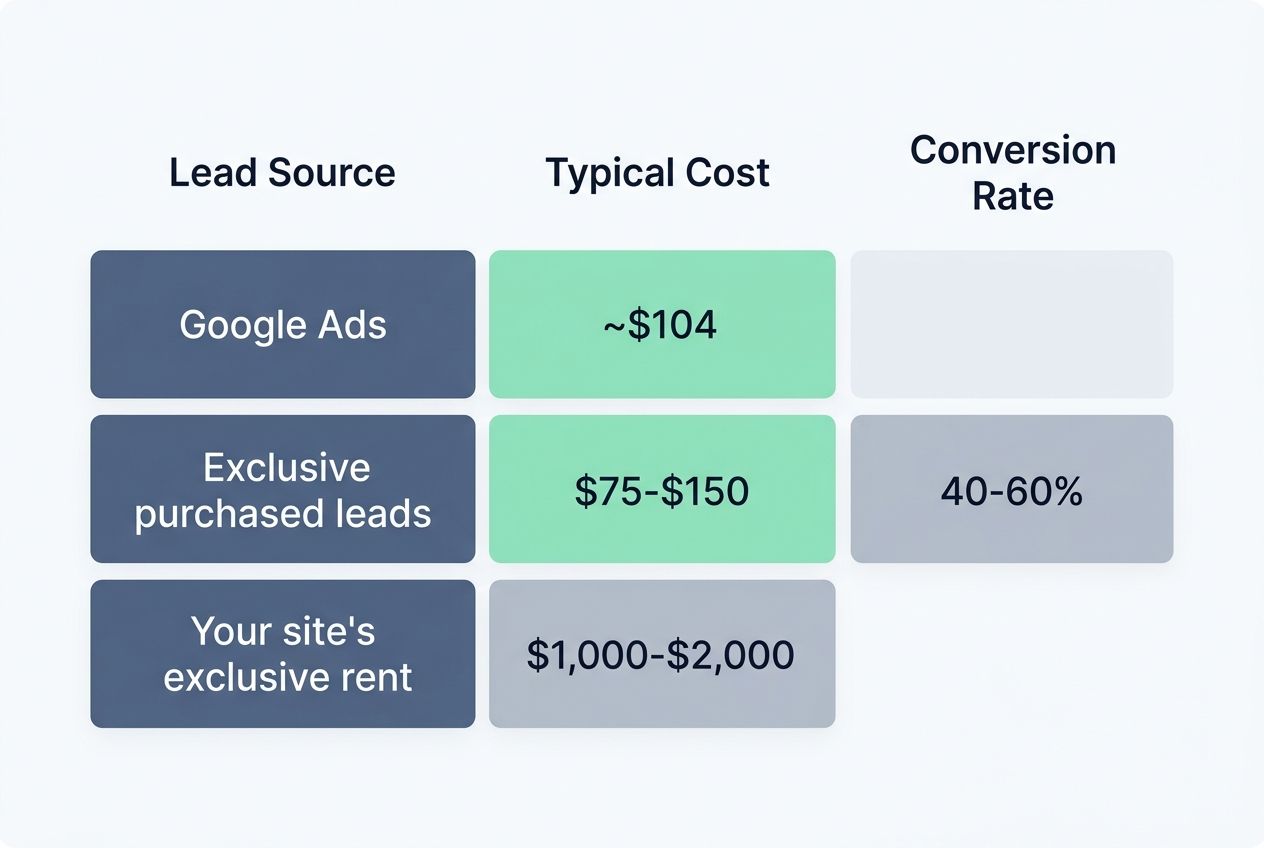
| Lead source | Typical cost | Conversion |
|---|---|---|
| Google Ads (HVAC/plumbing average) | ~$104 per lead | Varies |
| Exclusive purchased leads | $75 to $150 per lead | 40 to 60% |
| Shared purchased leads | Lower per lead | 10 to 20% |
| Your site's exclusive rent | $1,000 to $2,000 flat monthly | Renter keeps every call |
Individual leads carry less urgency than emergency calls, but the diversified flow creates steadier digital real estate that renters value, and the multi-trade coverage gives them cross-selling from a single partnership.
Example 3: the multi-city operator site
You target the same trade across multiple nearby cities, using either one domain with location pages or separate exact-match sites per city. The core trade stays constant; only the geography changes.
The two approaches trade off differently:
- One domain concentrates all authority into a single property and builds rankings faster through internal linking.
- Separate city domains capture exact-match local intent and rent independently to different businesses at $300 to $1,000 monthly per property. The satellite sites strategy covers when this route wins.
Lead tracking must segment by city so each renter sees accurate numbers for their market.

A multi-city tree care portfolio shows the economics in concrete terms. Four satellite city sites in neighboring mid-size markets each used unique local content, local citations, and separate call tracking numbers. Monthly figures per site averaged 22 organic calls converting to 9 paid jobs, with rent to local operators ranging from $350 to $900. Operating costs per site broke down to $120 for content and maintenance, $30 for citations, and $50 for hosting and tracking, leaving net margins between $55 and $700 monthly per site depending on rent level.
Splitting one trade across four city sites let the operator monetize each market separately while scaling lead volume predictably. Competition varies by city size: small towns rank fast with minimal work, larger metros demand real effort. Each city page or satellite site becomes a separate revenue stream, so the portfolio stacks.
Example 4: the niche directory
A niche directory works differently from the single-rent model. The site lists multiple providers of one niche across a defined area, like "best plumbers in Springfield," and several businesses pay at once: $100 to $500 monthly each for featured placement, lead access, or visibility.
This protects income substantially. If one business stops paying, earnings hold because the other providers keep paying.
The directory structure includes:
- Category pages organizing services by type
- Individual provider pages with detailed business information
- Comparison content that helps users evaluate options
- Lead routing that tracks which business receives each inquiry
The comparison content pulls double duty: it attracts organic traffic from users researching options, and it positions the site as a real resource rather than a thin listing page.
Local depth is the edge, because the national giants own the broad searches. Per Angi Inc.'s public financial disclosures and 2026 competitive analyses from Latterly.org and Koalagains, Angi pulls roughly $1.15 billion in annual revenue and Thumbtack around $400 million, growing 33 percent year over year. You don't out-rank them nationally. You win by building deep local authority and genuinely regional content they can't match at scale.
Building and ranking a directory takes longer than the classic play, but the payoff is durability: recurring revenue that compounds as you add providers, and no single point of failure.

The anatomy checklist: page by page
The reusable framework for auditing any rank and rent site before launch, or any site you're evaluating:
- Homepage states the service type and city in the main heading, making intent clear at first glance.
- Service pages target one specific job type each, using the exact phrase locals search.
- Location pages contain genuinely local content: landmarks, neighborhoods, service areas, never swapped-name filler.
- A contact form on every page, emailing each lead instantly on submission.
- A clickable phone number in header and footer for single-tap mobile calls.
- Trust signals: real reviews, licensing credentials, certifications, where they genuinely exist.
- FAQ and guide pages answering the questions the market actually searches.
- Schema markup telling search engines and AI assistants what the business offers and where.
- Call tracking assigning unique numbers or forms per traffic source, so lead volume is measurable per channel.
- NAP consistency: name, address, phone identical across every page.
What failing sites get wrong
Failing sites share predictable patterns that kill lead generation before any renter signs:
- Thin brochure sites. Three pages with minimal depth, expecting to outrank established competitors. Local rankings take months of real content, not weeks of hoping.
- Duplicate city pages. Swapping only the city name signals low effort and tanks rankings across the whole domain.
- Generic content that never answers the questions the audience actually asks.
- Slow, bloated themes. Per Google's Chrome UX Report data referenced in Amra & Elma's mobile speed roundup, only 43.4 percent of mobile sites meet Core Web Vitals thresholds. Most competitors already fail this bar, which makes speed one of the cheapest ways to stand out; fast static builds clear it by default.
- No call tracking, so lead delivery can't be proven and trust dies before negotiation starts.
- Renting too early, before first-page rankings hold, which produces unreliable lead flow and an unhappy first client.
Two more traps: buying domains before validating the niche (the validation checklist is an afternoon of work), and building backlinks too fast on new sites, which raises flags that can hurt permanently.
The fix is discipline: validate first, build deep service pages, run tracking from day one, keep the build fast, write genuinely local content, and hold the site until rankings prove lead flow.
Conclusion
The four archetypes target different markets, but they share the same core components. Emergency sites win on speed and phone-first design. Multi-service sites win on coverage breadth. Multi-city portfolios and directories win on stacked revenue streams.
The anatomy checklist applies to all four. Master it, and you can evaluate any site or plan your next build in minutes.
Next steps: the complete rank and rent guide covers the full process end to end, and the niches guide helps you pick what to build first.
FAQs
What does a working rank and rent website actually look like?
It targets one service and one city, ranks through genuine content depth, and generates calls that a local business pays to receive. Most successful examples look plain rather than flashy, with typically 8 to 12 service and location pages plus supporting guides.
Do I need a website builder, or can I build the site myself?
Either works when the fundamentals are strong. Hand-building teaches the most; generating the site from a business factsheet compresses the build from weeks to days, which matters once you're producing more than one asset.
How does rank and rent differ from affiliate sites?
Affiliate sites earn commissions on product sales and depend on merchant programs; rank and rent sites lease their rankings and leads to local businesses. The rental model usually produces steadier monthly income, because one tenant paying rent replaces thousands of scattered buyers.
Which archetype should a first-time operator build?
The emergency service site. It's the leanest structure, ranks fastest in small markets, and the phone-first design makes lead value obvious to renters. Directories and multi-city portfolios reward experience, so build them once one single-city site has proven your playbook.
Ready to build a rank-ready site?
Get 30+ pages, auto-applied images, and full SEO setup in minutes.
Get started