Rank and Rent Domain Strategy: Exact Match, Aged, or Brandable?
What each domain type does for a rank and rent site in 2026: exact match, the real risks of aged domains, when brandable wins, and a decision framework.

You have your niche. You have your city. Now comes the decision that shapes everything else: which domain will you register?
Most operators treat this choice as an afterthought. In practice, your domain influences how fast you rank, how much trust the site earns, and how many leads you deliver. The wrong pick can waste months of content creation. The right one shortens the path to rent.
Three options sit on the table. Exact match domains pack the keywords into the name. Aged and expired domains arrive with existing backlinks and history. Brandable domains trade keyword clarity for memorability and long-term identity.
Each carries real advantages and real risks, and each performs differently depending on niche, competition, and what the asset is meant to become. Here is the plan: all three domain types, what they actually deliver in 2026, and the exact criteria for picking your next one with confidence.
Key takeaways
- Exact match domains lift click-through and build instant clarity, but they limit expansion and invite over-optimization penalties when paired with thin content.
- Aged domains can shorten the ranking timeline through existing backlinks, but they demand a thorough audit to rule out spam signals or inherited penalties.
- Brandable domains scale across cities and services and build long-term business value, at the cost of the content doing all the ranking work.
- Single-city service sites tend to win with exact match; multi-city portfolios and directories need brandable names to avoid geographic lock-in.
- The domain affects ranking speed, renter trust, resale value, and lead volume, so it deserves more thought than most operators give it.
Why the domain decision matters
The domain sets the trajectory of the whole operation. You cannot swap it later without a costly migration that shakes rankings, lead flow, and renter confidence.
It shapes three things at once:
- How searchers perceive the site and whether they click through from results
- Whether renters trust the asset enough to sign
- What the site is worth if you ever sell the portfolio
Here is the piece of history that matters. Google's EMD update launched on September 27, 2012, announced by then-Google engineer Matt Cutts. Per SISTRIX's algorithm-update history and Search Engine Journal's retrospective, it affected roughly 0.6 percent of English-language queries and specifically demoted low-quality, thin-content sites leaning on keyword-stuffed domain names.
Note the distinction most people miss: Google targeted thin content, not exact match domains themselves. The keyword-in-domain shortcut died, but the domain was never the crime. The real decision now centers on positioning, memorability, and trust rather than gaming the algorithm. The domain works alongside the content and the tracking infrastructure. It never works alone.
Exact match domains: what they still do
Exact match domains (EMDs) like a city-plus-trade dot com no longer deliver an automatic ranking boost. The algorithm moved past that signal years ago.
What survives is the relevance signal to users. The domain mirrors the search query, which raises click-through on the results page, and visitors instantly know what the site offers. That clarity builds trust before anyone lands on the page, and for lead generation sites, instant recognition means higher conversion at zero extra cost.
What the numbers show

One operator ran two identical landing pages for a single-city plumbing niche, differing only in domain type. Over a 30-day period in a mid-competition US market, the exact match domain produced 17.2 percent higher organic click-through and a 9-point higher lead conversion rate on initial contact forms. Sessions were balanced to isolate organic behavior, and no penalty signals appeared during monitoring.
The takeaway: user perception still rewards keyword clarity in local service markets, even though the algorithm no longer does.
The trade-offs you cannot ignore
- Over-optimization risk. Pair an EMD with keyword-stuffed content and you trigger exactly the spam signals Google penalizes.
- The boxed-in problem. A trade-plus-city name blocks expansion into new cities or services without a rebrand.
- Weak brand identity. Generic EMDs lack the personality of real companies, so established brands can outmuscle them.
- Trust erosion. Hyphens and obscure extensions look sketchy. Dot com first, always.
EMDs work best in high-intent, low-competition niches where business owners search for exactly what the domain says. Confirm the demand with keyword research before buying the name.
Aged and expired domains: the real risk profile
Aged domains arrive with accumulated backlinks that can shorten the ranking timeline. That advantage hides serious risks: the price premium, and a link profile that may carry spam signals or penalties that transfer straight to your site.
One thing worth knowing before paying for "age" itself. As John Mueller explained in a Google Search Central hangout, cited by Search Engine Journal among others, domain age has zero SEO benefit on its own. Google uses domain history mainly to detect spam, not to grant a boost. Any real advantage comes from the accumulated backlinks and content, never the birthday on the registration record.
The pre-purchase audit checklist
- Check the domain's archive history in the Wayback Machine to see what actually lived there
- Examine the link profile for topical relevance and quality, not raw counts
- Verify no penalties or algorithmic flags attach to the domain
- Confirm the past content matches your intended niche, because a domain that ranked for something unrelated carries no value for your market
What a bad buy actually costs

One acquisition shows the price of skipping due diligence. An aged domain marketed for multi-service lead generation looked promising on marketplace metrics. A detailed audit then uncovered 62 referring domains, including 18 low-quality directories and 7 foreign-language spam farms. After a manual disavow file and six weeks of monitoring, organic visibility declined 14 percent against pre-acquisition snapshots. The operator rolled back to a clean rebuild. Total acquisition plus remediation costs hit $1,900. What looked like a shortcut became a quarantine project.
Treat aged domains as a tactical tool for established portfolios, not a first-site move. Your first site needs demand validation and lead tracking before you gamble premium pricing on expired inventory.
Brandable domains: when they win
Choose a brandable domain when you plan to scale across cities, services, or niches. A distinctive name gives up keyword signals but earns credibility with renters and consumers, who see a legitimate operation instead of a thin keyword play.
Brandable domains shine in three situations:
- Directories, which need to feel like a real publication to rank and to sell featured placements. Directory naming has its own conventions worth following.
- Multi-service and multi-city platforms, where a trade-plus-city name would box the asset in.
- Anything you might sell later, since buyers pay more for assets that read as businesses.
The catch: the content does all the ranking work, since the name carries no relevance signal. The payoff: you stand apart from competitors stacked on keyword-heavy names, and the asset survives pivots and market shifts. A brandable domain takes longer to gain traction, and that slower burn buys insulation from algorithm volatility.

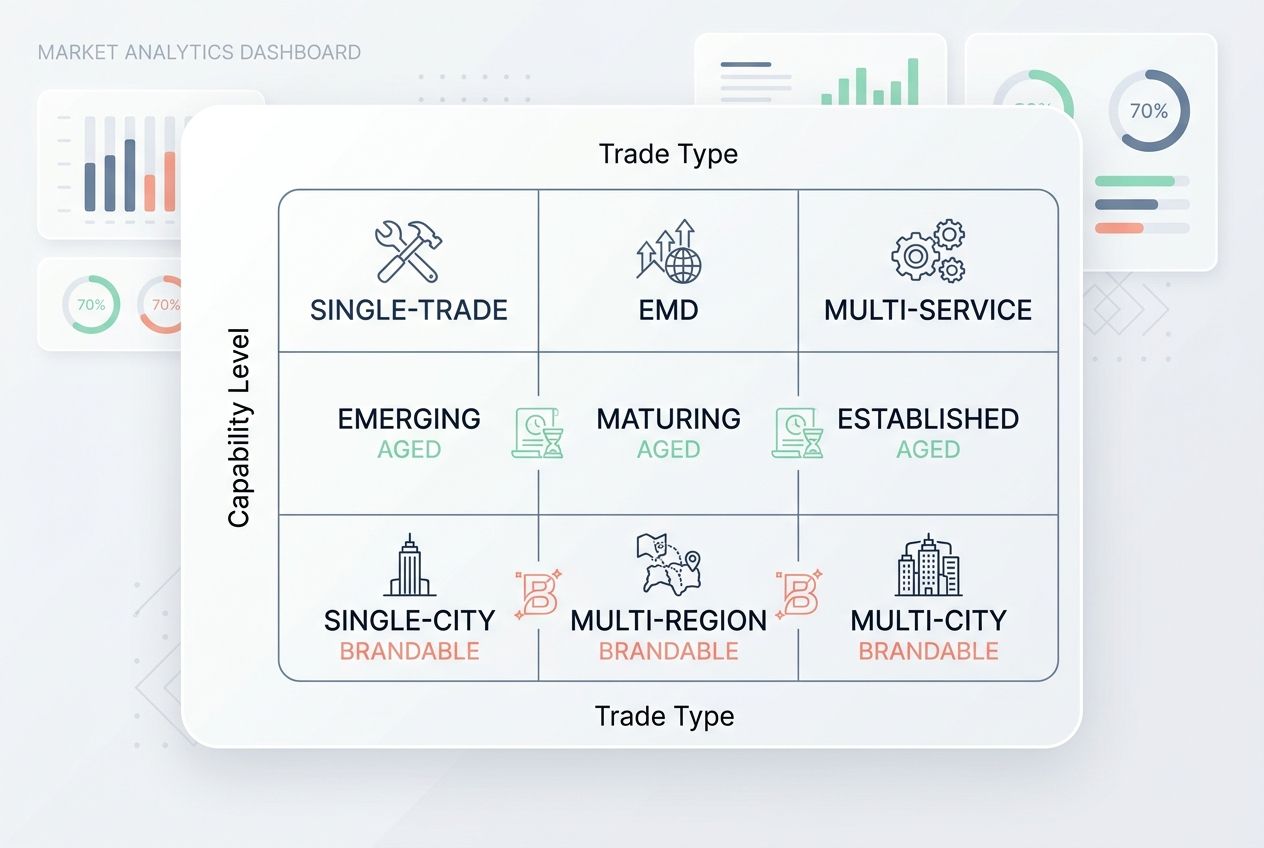
The decision framework
The domain follows the business model, not the other way around.
| Business model | Recommended domain | Why | Avoid |
|---|---|---|---|
| Single-trade, single-city site | Exact match | Relevance is obvious to searchers and the renter; fastest to a focused rental | Brandable names that hide what the site does |
| Multi-service trade site | Brandable, or trade-only EMD without the city | Room to add services without a rebrand | Job-specific names that box the site into one service |
| Multi-city expansion | Brandable hub, or per-city EMDs rented separately | Flexibility across markets, or exact-match intent per city | One city's name on a domain meant to cover five |
| Directory or aggregator | Brandable | Neutral authority across many providers; easier to monetize and sell | Any name that reads as one business rather than a publication |
Domain mechanics for operators
The operational details protect the asset and keep renters served.

The stakes behind the checklist: per 2026 local search data from industry trackers such as BrightLocal, US "near me" searches passed 200 million per month in early 2026, about 88 percent happen on mobile, and 76 percent of those searchers visit a business within 24 hours. That is the high-intent traffic every item below exists to capture.
- Register for multiple years and turn on auto-renew. A lapsed domain is a lost asset and a lost renter in one stroke.
- Consolidate every portfolio domain in one registrar account, so nothing expires unseen.
- Configure DNS cleanly, pointing straight at the host with no redirect chains. The custom domain guide covers the exact records.
- Confirm the domain resolves before the renter ever sees it.
- WHOIS privacy on by default. Renters do not need to look up ownership details.
- Mobile-responsive by default, since nearly nine in ten local searches arrive on a phone.
- Analytics and lead tracking on every domain from day one, so the rental conversation always has numbers.
Multi-site portfolios: one domain or many?
Scaling forces a fork. One brandable domain with city pages pools authority into a single property, is simpler to run, and builds topical relevance faster. Separate exact-match domains per city capture intent directly and each rents independently to a different business: your plumber site in Denver operates apart from your plumber site in Austin.
The trade-off cuts both ways: pooled authority builds faster, but separate domains create separate income streams once they rank.
The satellite sites hybrid
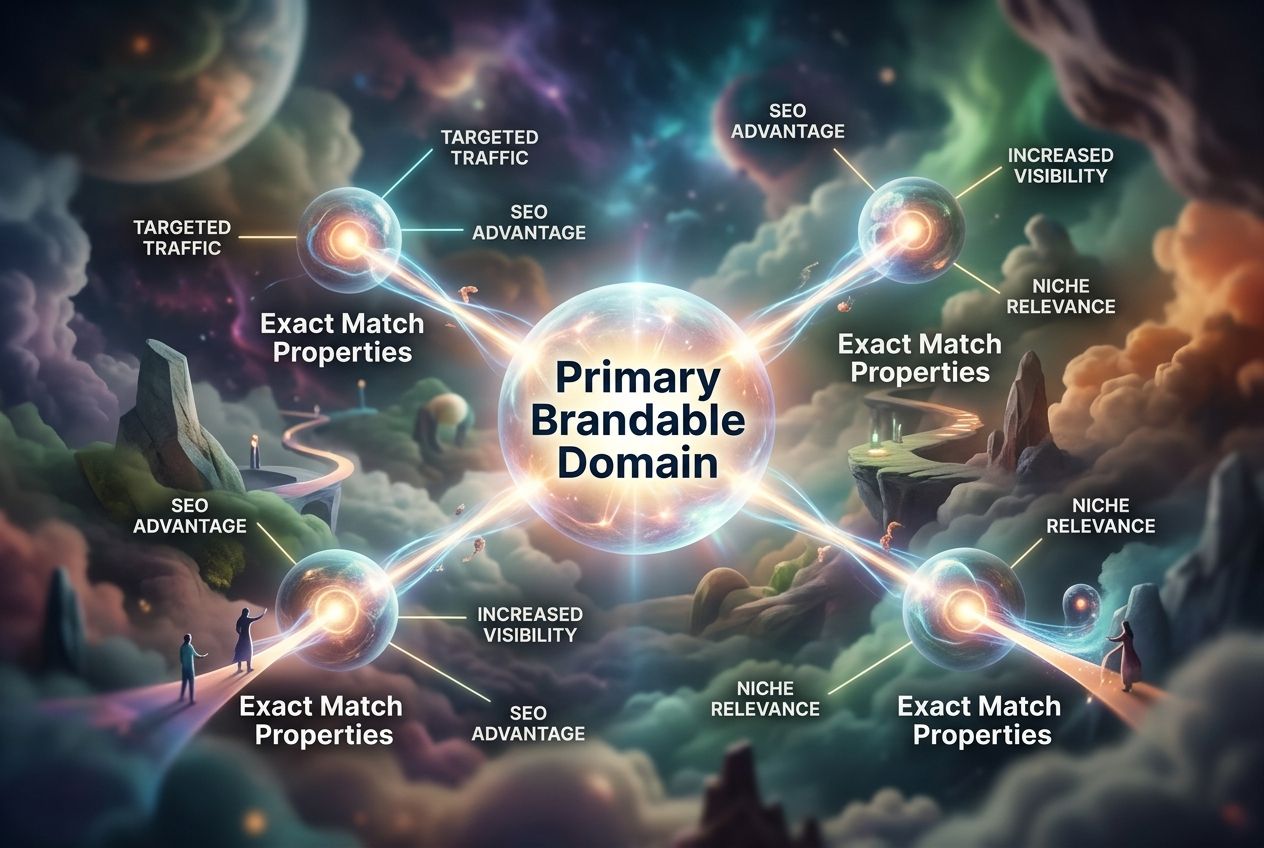
The hybrid resolves the tension for operators in multiple markets. Build one primary brandable domain as the authority hub, then launch exact-match properties as satellite sites where markets prove out.
This lets you test whether a city deserves its own domain before committing to ranking it from zero. Concentrate authority on the core domain until a location generates consistent rent, then spin out a dedicated exact-match domain where the lead volume justifies the effort.
Conclusion
The sequence matters: niche first, city second, domain third. That order keeps the domain tied to real market demand instead of a name you liked.
Match the type to what the asset is meant to become. Exact match for focused single-city lead flow, brandable for directories and anything built to expand, aged only after a competent audit and never as a first move.
The complete rank and rent guide covers the full process from build through lead delivery, and the site examples breakdown shows what each archetype looks like on each domain type.
FAQs
Do exact match domains still boost rankings?
Not by themselves, and not since the 2012 EMD update. What they still do is raise click-through and conversion, because the name mirrors the search. Rankings come from content depth, profile signals, and links, with the domain contributing clarity rather than algorithmic weight.
Are aged domains worth the extra cost?
They can shave two to three months off the ranking timeline when the link profile is clean and topically relevant. Quality aged domains now run $500 to $2,000 versus $10 to $15 for a fresh registration, and a spammed one sets you back further than starting clean, so the audit is not optional.
Should I pick a brandable domain instead of an exact match one?
If the asset might ever cover more than one service or city, yes. Brandable names build credibility with renters, avoid over-optimization risk, and leave every expansion path open. For a single-trade, single-city site you intend to keep focused, exact match still earns its click-through edge.
Which domain type ranks fastest?
None of them guarantees speed. Content depth, business profile signals where one exists, citation consistency, and link quality matter far more than the name, and typical rank-and-rent sites take three to six months to reach page one on any domain type.
Ready to build a rank-ready site?
Get 30+ pages, auto-applied images, and full SEO setup in minutes.
Get started