What Is Local Lead Generation and How Operators Make Money From It
Local lead generation explained for operators: how rank and rent, pay per lead, and retainers work, what the asset looks like, and realistic numbers by niche.

You know how everyone selling websites talks about traffic like it's the whole game? Operators who run portfolios know better. The real asset is owning the demand itself.
That's the core of local lead generation. You build a website, rank it for local service searches, and capture inquiries from people who need help right now. A local business then pays you for each qualified prospect, or rents the whole asset.
You're not selling marketing services. You're the middleman who owns the machine.
The model works because local businesses face the same problem everywhere. They need customers in their service area, but they lack the time or skill to build a real online presence. You build it for them, capture the leads, and charge for access.
Your role differs from a business owner buying leads. You never manage customer relationships or deliver services. You build and run a portfolio of sites targeting specific niches and cities, with local SEO and targeted content doing the heavy lifting.
How you get paid varies. Some operators charge per lead. Others use pay-per-call or flat monthly retainers, and that choice shapes both your revenue predictability and your margins.
This guide walks through how the model works, what a real lead generation asset looks like, the numbers operators earn by niche, and how to rank, track, and prove lead delivery so you get paid without disputes.
Key takeaways
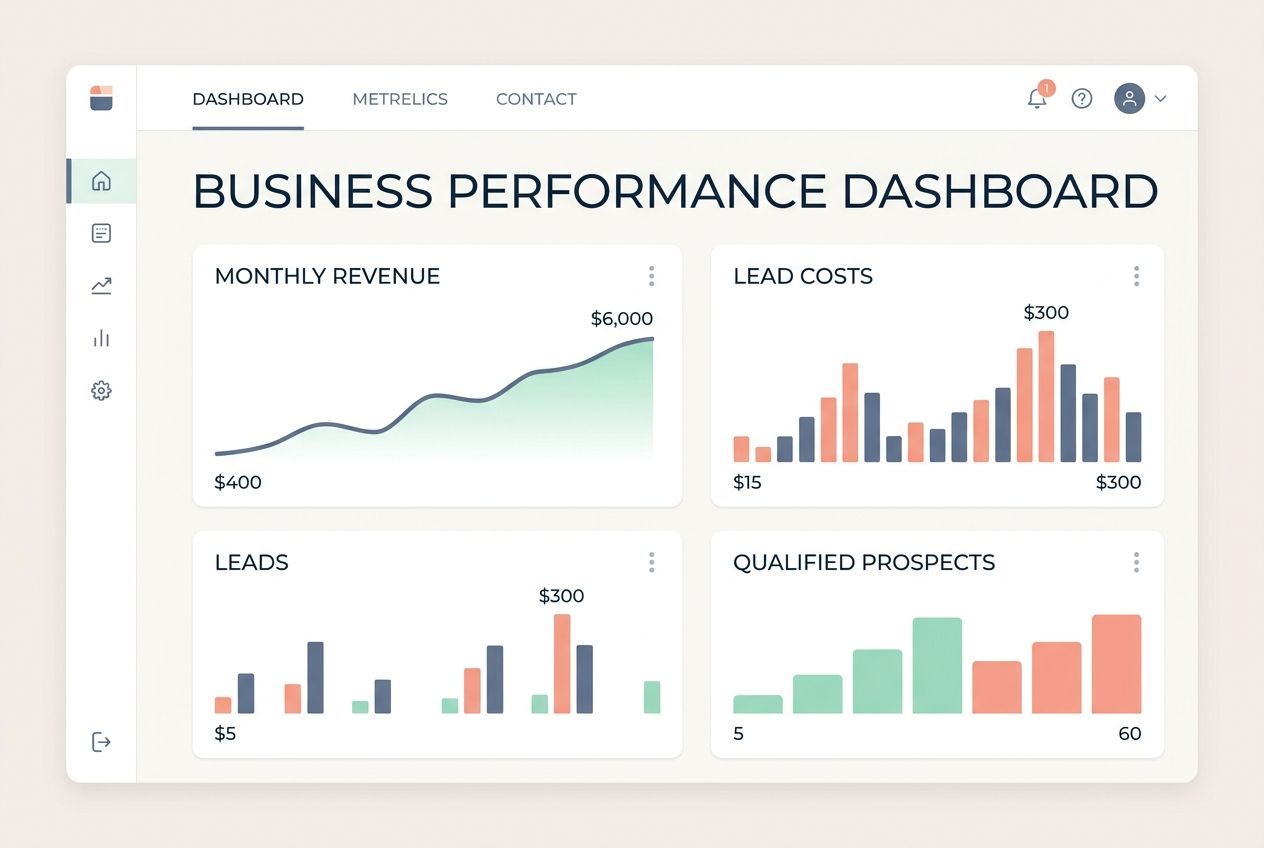
- Local lead generation operators build ranking websites that capture customer inquiries, then charge service businesses monthly fees or per-lead payments for qualified prospects.
- Service sites generate $400 to $6,000 monthly from single clients, while directory sites diversify revenue across multiple renters, reducing risk when clients leave.
- Roofing, HVAC, plumbing, and personal injury law niches command lead values ranging from $15 to $300, supporting monthly volumes of 5 to 60 qualified prospects.
- Operators own the ranking asset permanently. Once a site holds top local positions, it keeps producing leads without daily work.
- Start with one niche in one city, put lead tracking in place from day one, and open client conversations before rankings peak.
What is local lead generation
Local lead generation converts strangers into interested prospects for services within a specific geographic area. You capture leads by targeting people searching for solutions in your chosen market, then pass those qualified inquiries to local businesses that pay for each customer contact.
Three parties make up the ecosystem:
- The searcher with an urgent local problem
- The local business that pays for access to that searcher
- You, the operator, who owns the asset and controls the lead flow in the middle
Your ranking asset (a website optimized for local search and Google Maps visibility) becomes a traffic source you own outright, with no reliance on paid platforms. Google's own data puts the share of searches with local intent at nearly half of all queries, so the pool of searchers your assets can capture keeps growing.
Your profit comes from the gap between what you charge local service providers and what those leads cost you to generate. Unlike buying ads, where platforms control the traffic and the price of it, you own the ranking asset permanently. That's the difference between renting demand and owning it.
How the business model works
You operate a single business model that generates local leads for service businesses, but you get paid in three distinct ways depending on your agreement with clients.
The rank-and-rent approach rents out an asset you own. Pay-per-lead and pay-per-call price each inquiry individually. Flat monthly retainers provide predictable cash flow once you deliver consistent lead volume. Each structure fits a different stage of portfolio growth and a different client budget.
The rank and rent model
The rank and rent model separates site building from revenue generation (full explainer). You construct a local business website optimized to rank in a specific niche and geographic market.
Once the site ranks well in local search results, you rent the entire asset (or its lead flow) to a single local business for a monthly fee. That business gains exclusive access to every lead captured within their city and service area.
This exclusivity protects the renter's investment and keeps competitors away from the same lead source. Monthly rental fees typically range from a few hundred dollars to several thousand, depending on lead value and local competition.
One operator running a residential plumbing site in a mid-size market shows how lead volume translates to rental pricing. After four months of focused local SEO work, the asset averaged 22 tracked leads per month. The operator negotiated a $1,200 monthly rental based on a conservative $40 per lead valuation and a 30 percent conversion assumption from leads to booked jobs. The contract stayed month-to-month at first, giving both parties room to verify conversion rates before committing longer. That's how experienced operators price assets: documented lead volume, not speculation.
Building the asset itself is the part that has compressed most. Platforms like LocusPilot generate a complete static site from a business factsheet in days rather than the weeks a hand-build takes, which matters when you're running more than one of these.
Pay per lead and pay per call
Your clients pay only for qualified leads they receive, which makes pay-per-lead (PPL) pricing that ties spending to results. Each form submission or tracked phone call carries a specific price, and you set rates based on industry, competition level, and location.
High-value trades like roofing, water damage restoration, and towing generate substantial revenue per job, so their owners pay premium rates per lead. Real market data backs this up. A 2026 Local Services Ads spend analysis by SearchLight Digital put the average cost per home-services LSA lead at about $53 nationally, based on $6.72 million in ad spend across 888 contractors generating 126,650 leads.
The breakdown by trade gives you a pricing benchmark:
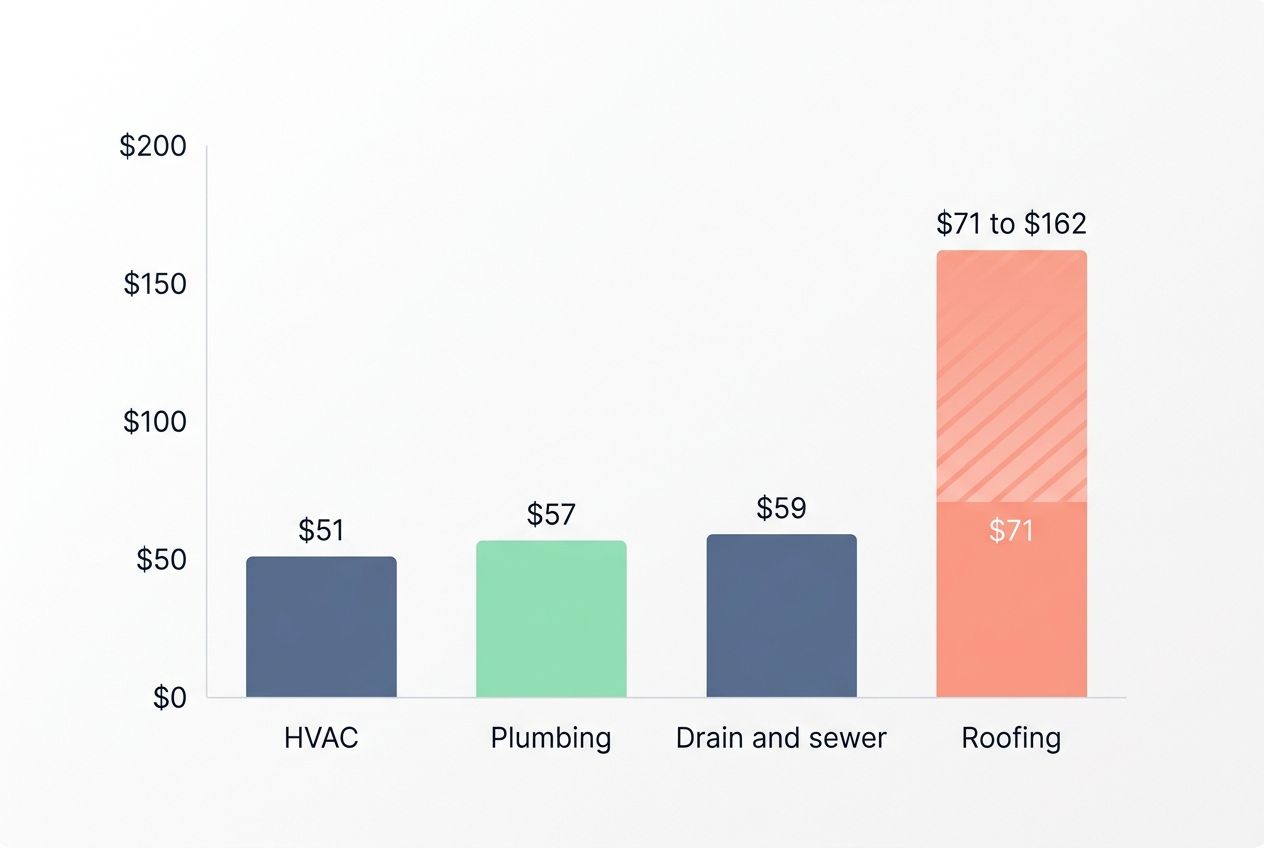
- HVAC: $51 per lead
- Plumbing: $57 per lead
- Drain and sewer: $59 per lead
- Roofing: $71 to $162 per lead
The same analysis found an average LSA booking rate of 43.9%, which puts the average cost per paying customer around $233. Why does that matter to you? If Google charges contractors $53 per lead through Local Services Ads, your organic leads at comparable or lower prices look like a bargain, and you have hard numbers to anchor your PPL negotiations.
Call tracking numbers serve as your standard proof mechanism, giving you clear documentation that leads arrived as promised. Pay-per-call frequently pairs with PPL in service industries, creating two revenue streams from the same asset.
Flat monthly retainers
You charge your renter a fixed monthly fee regardless of how many leads you deliver. This simplifies your accounting and cash flow projections since revenue stays consistent.
Flat retainers work best once you've proven your asset produces steady results. Your renter pays the same whether you deliver 10 leads or 50 that month, so you capture extra profit when the asset overperforms. Many consultants and small agencies prefer this structure because it removes payment disputes and cuts administrative overhead.
What a lead generation asset looks like
Your lead generation asset takes shape as either a service site or a directory site, and this choice shapes your entire strategy.
Service sites present one business in one trade. Directory sites list many providers in a niche across a city. The decision here sets the foundation for everything downstream, so it's worth comparing the two structures directly.
Service sites vs directory sites
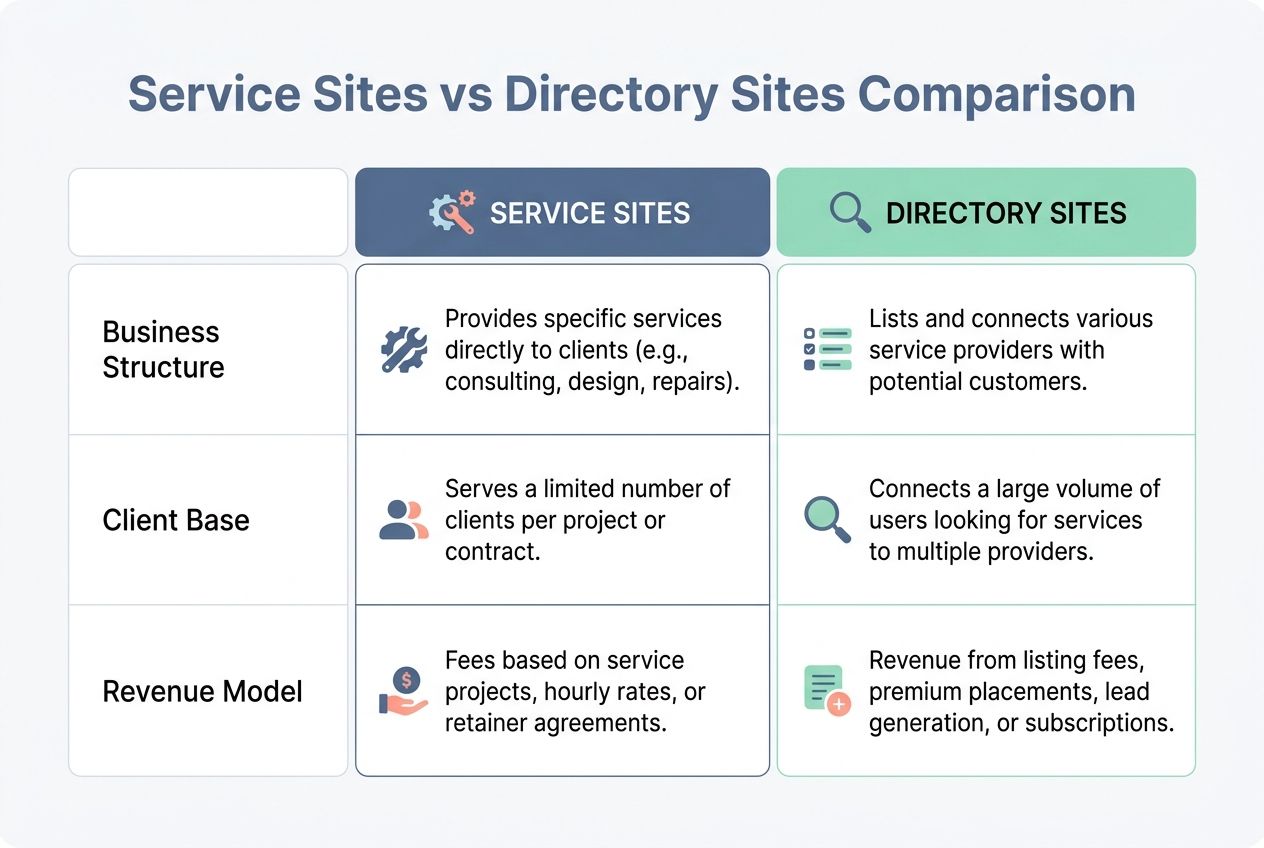
| Service site | Directory site | |
|---|---|---|
| Structure | One business, one niche, one city | Many businesses in a niche across a city |
| Who pays | One renting business | Multiple businesses via featured placement |
| Revenue | Single monthly retainer | Several placements plus lead distribution |
| Risk | All revenue stops if the renter leaves | Survives a single renter leaving |
| Timeline | Ranks faster with focused optimization | Takes longer, diversifies renter risk |
| Scaling | New site per client | Add featured tiers on the same domain |
Directory sites operate differently. Multiple business owners pay for featured placement within the same domain, so one renter leaving does not kill your cash flow. The trade-off is speed: directories take months longer to rank and monetize, but the payoff comes through diversification and compounding revenue as more renters claim featured spots. If the directory route fits your risk profile, the directory creation guide covers the build end to end, including scheduled listing refreshes that keep the directory current without manual updates.
Choosing between the models comes down to operational capacity and risk tolerance. Service site operators must continuously source new business clients to grow. Directory operators focus on converting existing directory visitors into featured placement customers. Both work; the difference is how you want to grow.
The pages that capture leads
Your lead capture pages function as the conversion engine of the asset. Service pages targeting exact search queries form the foundation, while location pages expand your reach across nearby towns.
The working parts:
- One clear next step per page: a form, a call, or a WhatsApp message
- Service pages matched to the exact jobs people search for
- Location pages capturing searches from surrounding areas
- A contact form on every page that emails each submission the moment it arrives
- A clickable phone number placed prominently
- Trust content like guides and FAQs that make the site the obvious answer in its niche and city
Every page should do one job: turn a visitor with a problem into a logged, attributable inquiry.
How operators get paid: the numbers
Your earnings depend on the model you choose, the market you target, and how consistently you deliver. Different niches command different lead values, and monthly income scales accordingly.
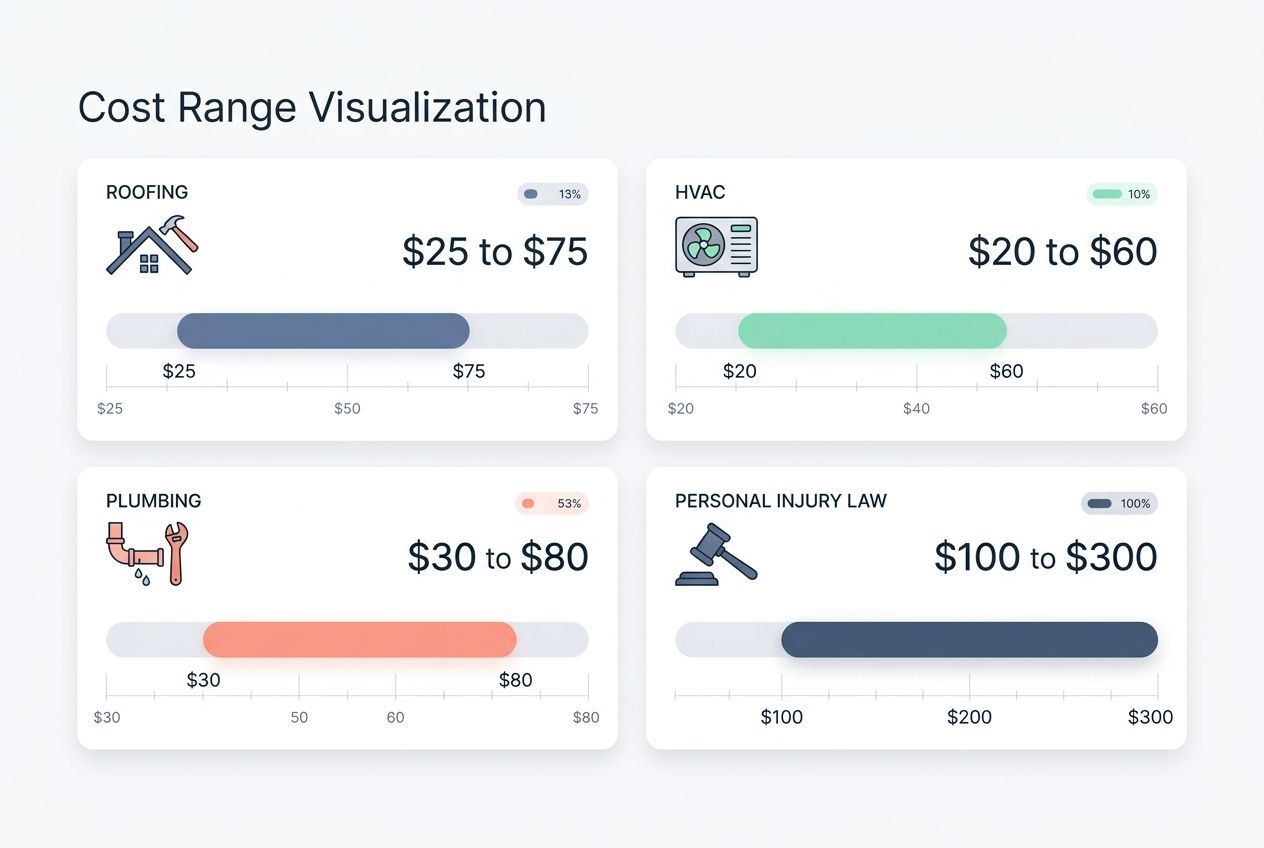
| Service niche | Typical lead value | Monthly leads (conservative) | Monthly revenue range |
|---|---|---|---|
| Roofing | $25 to $75 | 15 to 40 | $400 to $2,500 |
| HVAC | $20 to $60 | 20 to 50 | $400 to $3,000 |
| Plumbing | $30 to $80 | 12 to 35 | $360 to $2,800 |
| Junk removal | $15 to $45 | 25 to 60 | $375 to $2,700 |
| Landscaping | $18 to $50 | 18 to 45 | $324 to $2,250 |
| Personal injury law | $100 to $300 | 5 to 20 | $500 to $6,000 |
The time-to-first-dollar guidance most operators use: a new site in a weak-competition niche takes roughly three to six months to produce its first steady lead flow. Plan client conversations around that timeline rather than promising instant results. For the full first-year math, including break-even timing and what a ranked asset sells for, see the business model economics breakdown.
Ranking the asset in local search
Ranking the asset takes a mix of technical work and content architecture. You need visibility in both the map pack and organic results to maximize lead flow, and increasingly in AI search results too.
The strategy-level checklist:
- Target keywords you can win within three to six months: service areas with real demand but weak incumbent sites, not oversaturated metro head terms.
- Build out full topic coverage, with each page targeting a specific service or location variation, connected by deliberate internal links so authority flows to the money pages.
- Optimize the Google Business Profile completely where the asset has one: accurate information, service areas, photos, posts.
- Get pages indexed quickly instead of waiting weeks for a crawl. LocusPilot handles index submission in bulk across a portfolio.
- Help your renters accumulate reviews. BrightLocal's 2026 Local Consumer Review Survey found 68% of consumers now require a minimum 4-star rating before considering a business, up 13 points in a year. A renter above that threshold converts your leads better, which makes your asset easier to price.
- Watch AI search visibility alongside the map pack. AI assistants now answer "who should I call" questions directly, and sites structured for machine readability get cited. The Vibe SEO guide covers how this changes local ranking work.
This is deliberately a strategy list, not a full tutorial. Each item above links to a deeper guide where the mechanics live.
Tracking and proving lead delivery
Your renters demand proof before they send another payment. This is the part of the business that determines whether month one becomes month twelve.

Every form submission must reach the renter's inbox the moment it arrives, creating an undeniable record of delivery. Every phone tap, WhatsApp tap, and outbound click should be logged with its traffic source and the visitor's city. When the invoice goes out, the number on it matches a log both sides can see, and the dispute never starts.
One operator running three newly indexed service sites tracked form routing to renter inboxes during the first 30 days after launch. In that month, 98 of 102 form submissions reached both operator and renter inboxes within 12 seconds. Four submissions were delayed six to 18 minutes due to spam filtering on the renter's email server. The near-instant delivery on most submissions made it simple to prove lead delivery at invoice time, cutting out the back-and-forth that delays payment and erodes trust.
Speed matters commercially, not just operationally. Google's research on "near me" behavior has found that around three quarters of people who run a local search visit a business within a day, and over a quarter buy within 24 hours. Slow lead routing means your renter's prospect has already hired someone else. Fast delivery is a selling point you can put in front of every client.
Managing multiple sites demands centralized visibility, not scattered spreadsheets. LocusPilot delivers every form submission by email as it arrives, tracks CTA clicks across phone, WhatsApp, email, and outbound links with source and city-level attribution, and rolls the whole portfolio into one dashboard. Monthly reports showing volume, quality, and source attribution justify your fees without a single awkward conversation.
Local lead generation vs other online business models
Seeing how local lead generation stacks up against the alternatives helps you decide where to invest your time and capital.
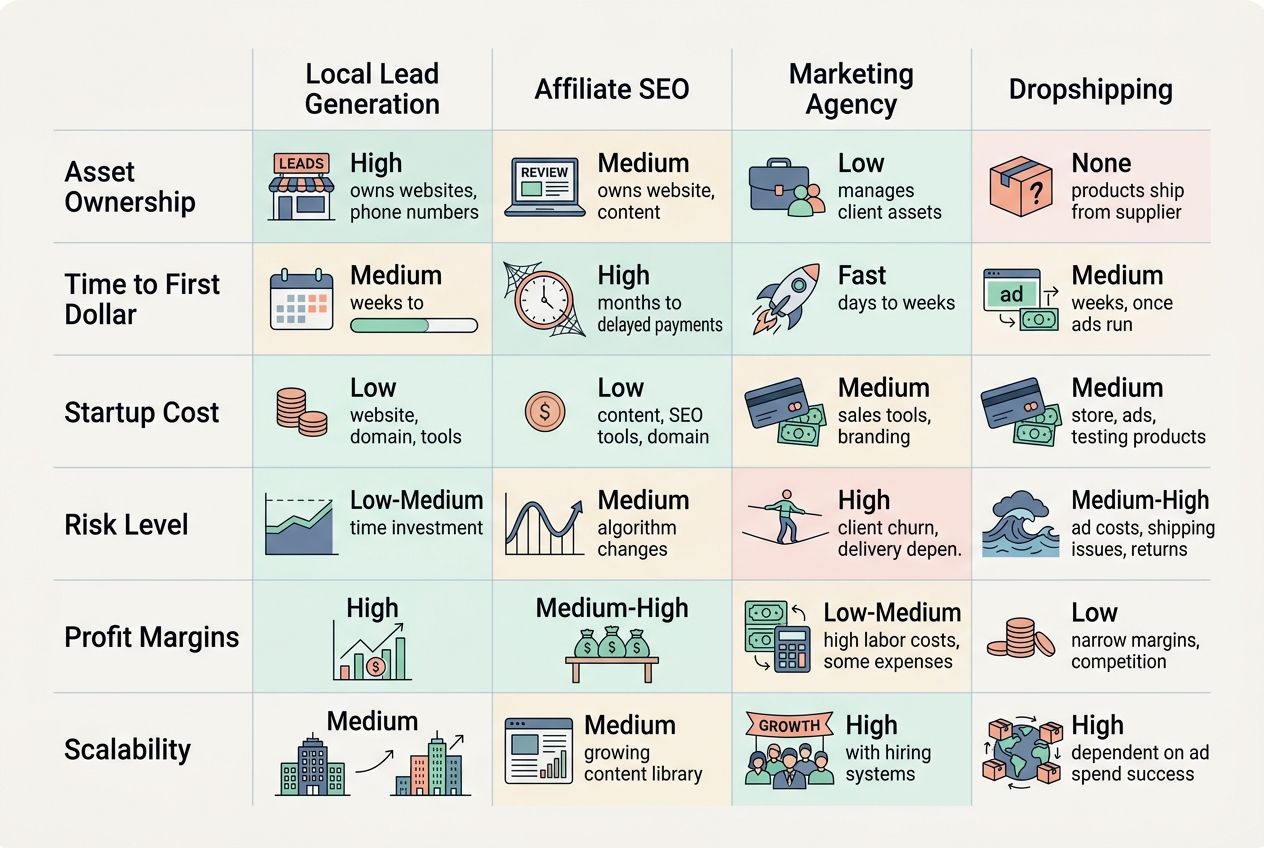
| Local lead gen | Affiliate SEO | Marketing agency | Dropshipping | |
|---|---|---|---|---|
| Who pays you | Local service businesses | Merchants via commissions | Direct clients | End customers |
| Revenue type | Recurring (rent, PPL, retainer) | One-off commissions | Recurring retainers | One-off sales |
| You own the asset | Yes, site and rankings | Content, but ranking-dependent | No, clients own everything | Inventory only |
| Time to first dollar | 3 to 6 months | 2 to 4 months | 1 to 4 weeks | 1 to 2 weeks |
| If you stop working | Leads keep flowing while rankings hold | Declines without upkeep | Stops immediately | Stops instantly |
| Income stability | High once ranked and rented | Algorithm-exposed | Client-churn-exposed | Ad-cost-exposed |
One update worth flagging for anyone still referencing older Google credentials: per Google's Local Services documentation, the separate "Google Guaranteed" and "Google Screened" badges were consolidated into a single "Google Verified" badge, and the standalone money-back guarantee program tied to the old badge was discontinued. If your renters run Local Services Ads alongside your organic assets, make sure they're on the current terminology.
How to get started
Start small, execute in order, and build momentum before scaling across markets.
- Pick one niche and one city you can win. Job values above roughly $200, urgent demand, and weak incumbent sites. Prove the model once before repeating it.
- Build the asset with full topic coverage: every service page, every location page, a form and phone number on all of them. Generating the site from a factsheet collapses this step from weeks to days.
- Get indexed immediately. Submit the sitemap in Search Console and push new pages to the index rather than waiting for a crawl.
- Put tracking in place from day one, before the first lead, so every future inquiry is logged and attributable.
- Start outreach before rankings peak. The businesses already advertising in your niche have proven budget. Offer the first two weeks of leads free as proof, then move to paid. A live call log closes deals better than any pitch deck. One structured approach used across 14 pilot markets (landing page previews in outreach, a two-week free trial with tracking numbers, then a first-month performance credit) converted 18 percent of outreach contacts into trials, and 67 percent of those trials into paid monthly contracts.
- Resist launching ten sites at once. Finish one, rent it, then repeat the system in the next city or niche.
The next article in this series covers starting a local lead generation business step by step, from niche selection through the first paying renter.
Conclusion
The model is three steps. You build a ranking asset that captures real inquiries in a market that needs them. You track every lead so delivery is provable. You collect monthly payments from a business that depends on the flow.
It works because service businesses everywhere struggle to fill their pipeline, and because a ranked local site is an asset that keeps producing after the work is done.
Pick one service category and one city this week, then look at who currently ranks there. That's your first market research, and it costs nothing.
FAQs
What is local lead generation in one sentence?
You build and rank websites that capture inquiries for local services, then charge the local business for those inquiries through rent, per-lead pricing, or a monthly retainer.
How do operators actually make money from it?
Operators generate calls and form submissions in trades like roofing, HVAC, or junk removal, then charge the business a monthly rent for the site, a price per lead, or a flat retainer. The model works because a contractor will gladly pay $500 to $2,000 monthly for exclusive, prequalified inquiries instead of gambling on ads.
Which channels drive the leads?
Organic local search does the heavy lifting: ranked service and location pages, map pack visibility where the asset has a Google Business Profile, and increasingly AI search results that cite well-structured local sites. Email delivery and call tracking then move each lead to the paying business with proof attached.
Is local lead generation still worth starting now?
Yes, with the right market selection. Operators who target underserved niches and smaller cities face thin competition and close renters faster than those chasing saturated metros. The growing share of searches answered by AI assistants also rewards operators whose sites are structured to be read and cited by machines, which most incumbent local sites are not. The legality and viability breakdown covers both questions in depth.
Ready to build a rank-ready site?
Get 30+ pages, auto-applied images, and full SEO setup in minutes.
Get started