How to Start a Local Lead Generation Business
The five-step sequence for starting a local lead generation business: pick a winnable niche, build the asset, get indexed, land the client, prove every lead.

You know how most people chase online income through affiliate marketing or AdSense and end up with pennies? Local lead generation flips that script. You build one website, rank it in one city, and a local business pays you every month for the qualified leads it produces.
Thousands of operators run this exact model today.
Here's the honest part most guides skip: the timeline is four to eight months to a rented, revenue-producing asset, not four to eight weeks. Patience beats speed in this game. You'll need to understand local keywords, how the map pack works, and how to prove lead delivery well enough that a business keeps paying.
The payoff is worth the wait. You end up owning an asset that captures real customer inquiries and produces income after the work is done, instead of managing someone else's campaigns forever.
This guide covers what the business actually is, then walks the five steps in order: picking your niche and city, building the asset, getting indexed, finding the business that pays you, and tracking every lead through to payment. It finishes with real startup costs and the mistakes that kill new operators.
Key takeaways

- A local lead generation business captures customer inquiries through ranking websites, then charges local service providers monthly rent or per-lead pricing for qualified prospects.
- Select niches where jobs cost $200 or more and demand is urgent, targeting cities of roughly 50,000 to 200,000 residents to balance competition and search volume.
- Most operators see real traction within four to eight months, not weeks. The model rewards consistent execution over bursts of effort.
- Start outreach to potential paying clients while the site is still climbing, not after rankings peak.
- A realistic first-site investment runs $534 to $1,640 including domain, hosting, content, tracking, and six months of operating costs.
What a local lead generation business is
A local lead generation business builds and ranks websites that capture customer inquiries for local service providers. You then charge the business owner rent, per-lead pricing, or a retainer for each qualified inquiry your website produces.
This differs from client work in one big way: you own the asset and the traffic source. You're not managing someone else's campaigns.
The demand side is bigger than most new operators realize. The SBA counts more than 33 million small businesses in the US, and a large share of the local service businesses among them struggle to generate enough qualified leads on their own. That's the gap you're stepping into.
Your role centers on three functions:
- Attract: pull in potential customers through ranked service pages, local content, and Google Business Profile visibility where the asset has one.
- Filter: screen inquiries so the quality stays high enough to charge for.
- Connect: deliver them to a local business willing to pay for appointments or inquiries.
Unlike affiliate marketing or AdSense revenue, you control pricing and the client relationship. The same traffic source pays you month after month. The pillar guide on local lead generation covers the full model, the economics breakdown shows the first-year numbers, and the legality guide answers the compliance questions; this article is the how-to.
Step 1: pick a niche and city you can win
Your first decision shapes everything that follows. You need a niche where local businesses badly need customers and can afford to pay for leads.
Check job value and urgency first
Target services where customers typically spend $200 or more, so the business owner can justify paying for leads without hesitation.
The lead pricing data backs this up. Across current HVAC and plumbing lead-generation benchmarks, HVAC leads sell for $30 to $90, and plumbing leads run $15 to $85 shared or $40 to $100 exclusive. Marketplaces like Angi and HomeAdvisor resell the same plumbing lead to three or four contractors at once for $25 to $120 each.
Here's why that matters for you: business owners already pay real money for leads they have to share with competitors. An exclusive lead from your site, in their city, is worth more than anything a marketplace sells them. That's your pricing power.
Urgency separates winners from losers too. A plumber gets calls at midnight when pipes burst. That emergency demand means customers pay premium prices, and the businesses serving them actively hunt for lead sources because they lose revenue without steady flow.
Size the city right
Pick a city small enough that the competition stays manageable, yet large enough to produce consistent monthly searches. A city of 50,000 to 200,000 residents is often the sweet spot for a first site.
Compare a strong first pick against a weak one:
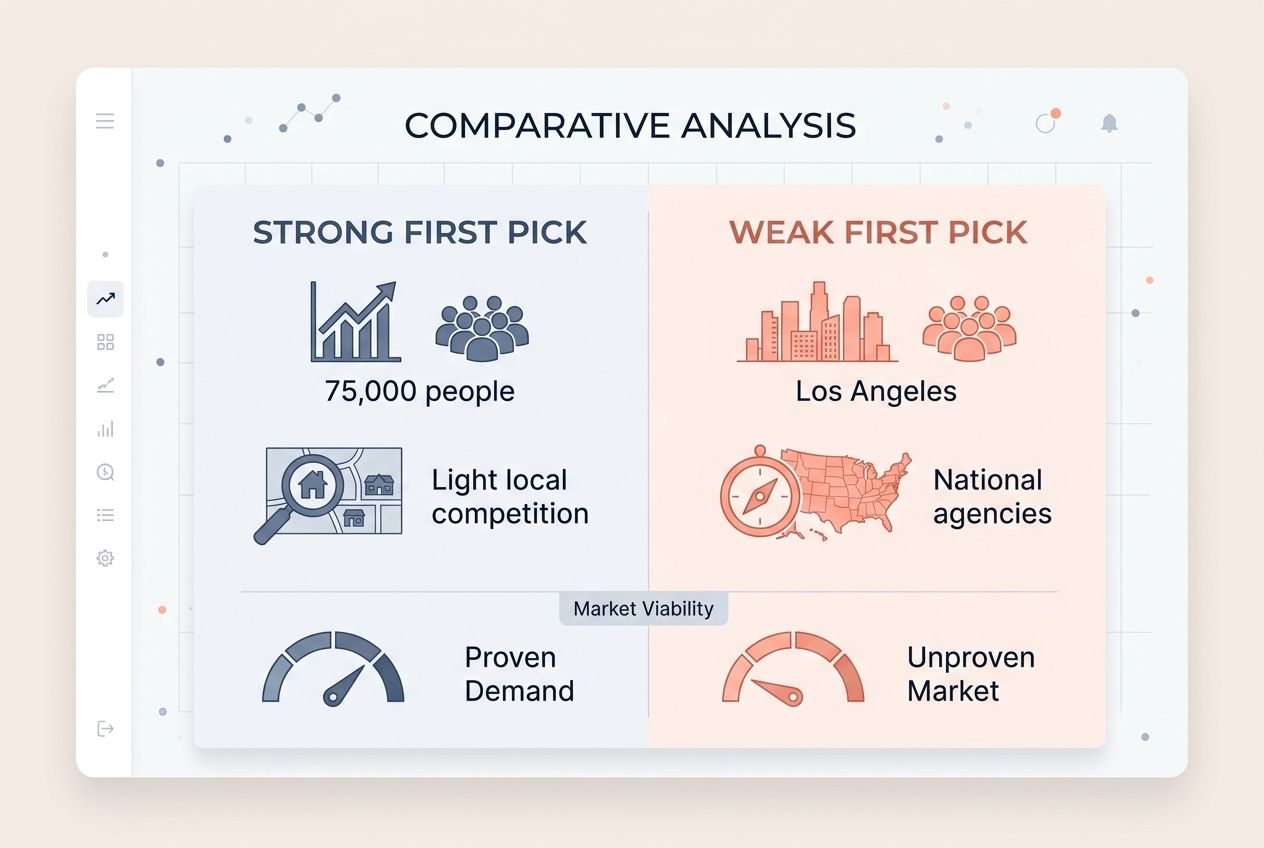
| Strong first pick | Weak first pick |
|---|---|
| HVAC repair in a community of 75,000 people | General home services across a major metro like Los Angeles |
| Light local competition, owners understand acquisition costs | National agencies and established operators already control rankings |
| Reasonable ad costs, faster organic ranking timelines | High ad costs drain the budget with little return |
Step 2: build the lead generation asset
Building the asset means creating a website that converts searches into logged, attributable inquiries. You'll choose between a single-business service site and a directory listing multiple businesses, then fill it with content deep enough to rank.
What the site needs:
- A service page for each specific job type your market searches for, each answering the exact questions customers ask in that niche and city.
- Location pages if you serve several towns, so each area has dedicated content. The satellite sites guide covers the multi-city version of this play.
- A contact form on every page, so a visitor can convert at any point in the site.
- A clickable phone number placed prominently for mobile users.
- Real content depth: enough guides and FAQs that the site is the best answer in its niche and city, not a three-page brochure.
- Lead capture wired from day one, with every form submission emailed the moment it arrives.
The build itself is the step that has compressed most. Generating the site from a business factsheet collapses it from weeks of development to days, and if you're going the directory route, the directory builder does the same for multi-listing sites.
Step 3: get indexed and start ranking
Getting indexed quickly shortens your path to the first lead. Don't wait weeks for an organic crawl.
The working sequence:
- Submit your sitemap to Google Search Console immediately so every page is signaled to Google on day one.
- Push new pages to the index rather than waiting for discovery. Bulk index submission covers a whole portfolio in one pass.
- Build internal links between service and location pages so authority flows through the site structure.
- Add pages over time in a deliberate sequence, so coverage deepens and indexing momentum stays consistent, instead of launching everything at once and going quiet.
- Prioritize the Google Business Profile where the asset has one. Local ranking-factor surveys consistently put GBP signals at roughly a third of local pack ranking weight, the single largest factor, and BrightLocal's research has found listings with 50 or more reviews earn over four times more clicks than listings with fewer than five. That gives you a concrete review target to chase.
- Structure the site for AI search engines now. AI assistants answer "who should I call" questions directly and cite readable, well-structured local sites.
- Track visitor behavior from the start with CTA click tracking across phone, WhatsApp, email, and outbound clicks, so you know which pages convert in your city.

Expect a new domain in a weak-competition niche to rank within three to six months of consistent execution.
Here's what that looks like in practice. One operator launched a plumbing site in a city of 75,000 residents using bulk indexing submission plus three localized service pages. Before submitting the sitemap, zero pages appeared in Google's index. After the bulk submission and sitemap push, all 12 pages indexed within 48 hours. By day 14, eight service keywords ranked on page two and two location pages hit the top ten. Within six weeks the site captured seven form submissions and three tracked phone calls from organic local searches. That validates the three to six month window for weak-competition markets, with the first leads arriving well before rankings peak.
Step 4: find the business that pays for the leads
Most operators make a critical mistake: they wait until the website ranks before searching for paying clients. Start outreach while the asset is still climbing.
Identify businesses already spending money on ads in your niche and city. Their ad budget proves they value customer acquisition, which means they've already demonstrated they'll pay for leads.
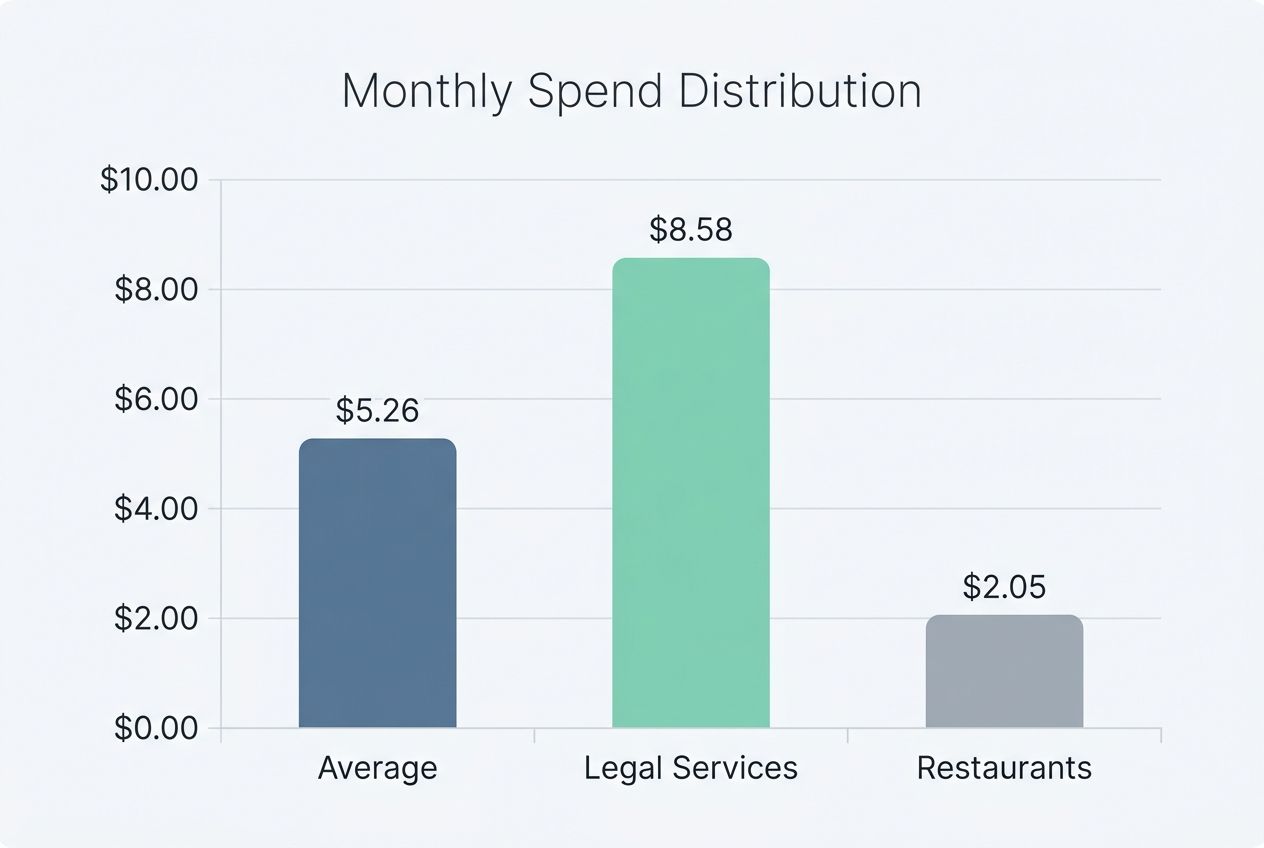
The numbers show how much these advertisers already spend. WordStream's Google Ads benchmarks put the average cost-per-click across industries at $5.26, up from $4.66 the year before, with legal services averaging $8.58 per click at the high end. A business paying $5 to $9 for a single click, with no guarantee of a lead, is a prime prospect for your fixed-price exclusive leads.
Your pitch needs one or two sentences: exclusive inquiries from people in their city actively searching for that specific service.
Remove the risk, then charge
Offer your first leads free for two weeks as proof of quality. This removes all risk from their decision. After two weeks, transition to a paid arrangement.
One operator started outreach during month two with 12 cold emails and 8 phone contacts over 10 days. The response rate hit 25 percent: three positive replies from 20 total attempts. One mid-sized HVAC company accepted the two-week free trial. During the trial, the site delivered five qualified form submissions and two booked appointments. Those results convinced the HVAC partner to commit to a $350 monthly retainer the moment the trial ended.
Early outreach works even while rankings keep climbing.
Closing deals requires proof, not polished presentations. A live look at your form log or incoming call tracking beats any pitch deck. Show the business owner submissions arriving in real time. Track every metric carefully so you can speak concretely about lead quality and volume during the negotiation.
Step 5: track, deliver, and get paid
Your tracking system must show every lead to both sides. That transparency is what turns a skeptical first month into a long-term renter.
The system, end to end:
- Deliver form submissions to the business by email the moment they arrive, while the prospect is still hot.
- Log every phone and WhatsApp tap with timestamps, so there's concrete proof of each interaction the business received.
- Attribute traffic sources at the city level, so you know which channels drive the highest-quality leads in each market.
- Generate a monthly performance report showing lead count and sources, and attach it to the invoice. Documented delivery makes payment approval routine instead of a negotiation.
- Run it all from one dashboard once you pass one site. Per-site spreadsheets stop scaling at exactly the moment your portfolio starts to.
Automating the capture and delivery side removes the manual data-entry errors that damage client relationships. The renter sees the same log you do, and the dispute never starts.
Startup costs and timeline
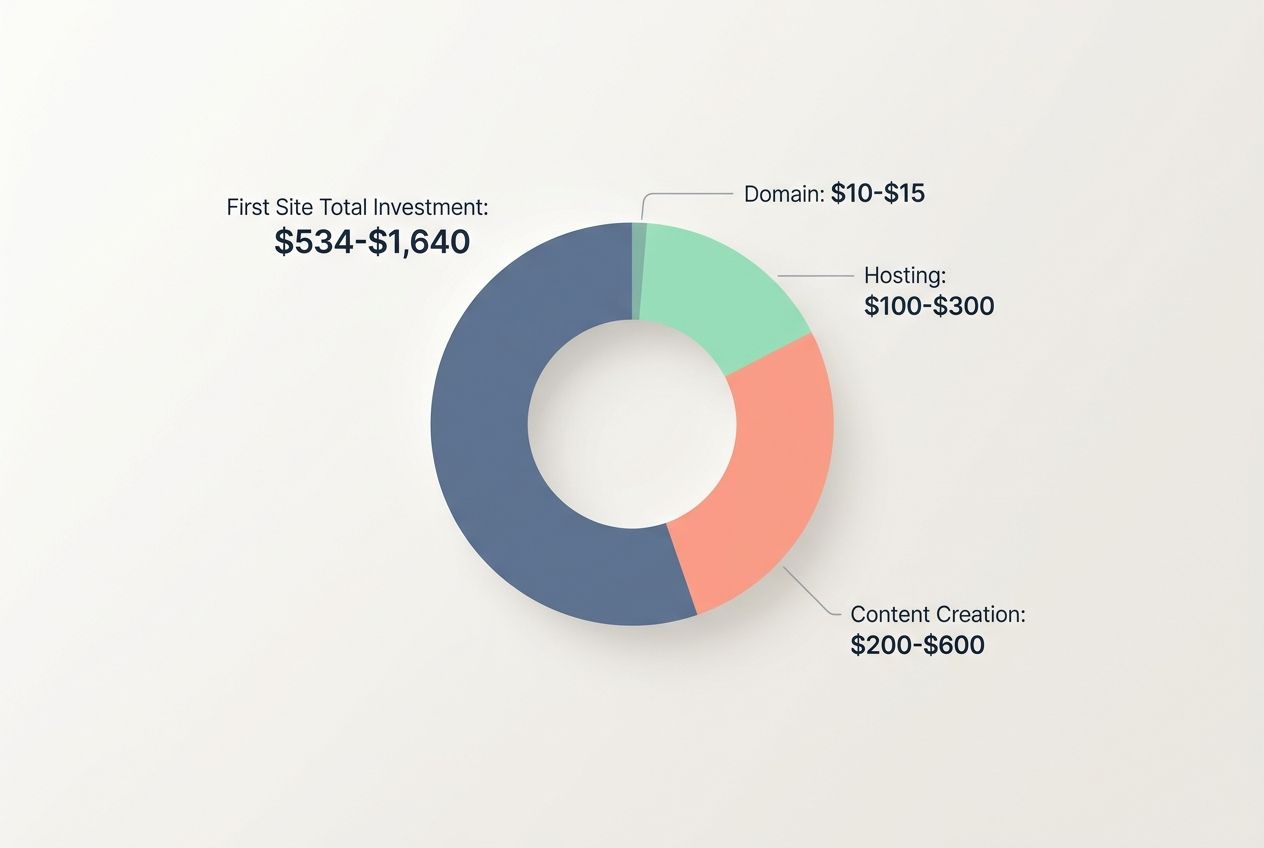
Building your first site requires upfront investment across a few categories. Knowing the numbers up front lets you plan a realistic budget.
| Startup line item | Cost range | Notes |
|---|---|---|
| Domain registration | $10 to $15 | Annual registration for a local domain with geographic keywords |
| Hosting or site platform | $100 to $300 | First-year hosting and SSL |
| Initial content creation | $200 to $600 | Landing pages, service descriptions, foundational local content |
| Call tracking setup | $50 to $150 | First month of call tracking and lead attribution |
| Platform subscription, month 1 | $29 to $97 | LocusPilot Operator at $29/mo or Growth at $97/mo |
| Months 2 to 3 operations | $58 to $194 | Subscription through the indexing phase |
| Months 4 to 6 operations | $87 to $291 | Subscription through the ranking window |
| First site total | $534 to $1,640 | Domain, hosting, content, tracking, and six months of operations |
| Phase | When | What happens |
|---|---|---|
| Setup | Weeks 1 to 2 | Domain, hosting, initial content deployed |
| Indexing | Weeks 3 to 6 | Search engines crawl and index the site |
| Early ranking | Weeks 7 to 12 | First keyword rankings appear, local visibility grows |
| Growth | Months 4 to 6 | Consistent lead flow begins, first client payments expected |
Mistakes that kill new operators
Most new operators fail from a handful of predictable errors, not bad luck.

- Picking a niche where jobs are too small to support lead payments. Rural plumbers may only pay $15 per lead, the bottom of shared marketplace pricing, versus $40 to $100 or more for exclusive leads. Competing at shared-lead prices is the trap.
- Launching ten websites at once instead of perfecting one. The scattered approach keeps you from learning what actually ranks before you multiply the mistakes.
- Delaying outreach while chasing perfect rankings. Starting conversations at month three beats waiting until month six for top positions.
- Skipping tracking, so renters dispute lead counts and refuse payment. Without documentation you lose credibility and income.
- Building thin three-page sites against established businesses with deep content. Thin content loses the authority battle every time.
- Quitting at month two, before the compounding starts. Most operators see real traction between months four and six, so early abandonment costs everything.
- Never measuring performance, so you can't tell what's working or improve what isn't.
Conclusion
Starting a local lead generation business comes down to finishing one asset in one market before touching the next. Your first website is your proof of concept. Once it produces consistent revenue, you replicate the system in a new city or niche. The one-site-first principle separates operators who build portfolios from those who scatter their effort and never finish anything.
Your move this week is simple. Pick your target city and research three local service industries that struggle with customer acquisition. Document which businesses currently rank on Google, and note the gaps your site could fill. That's the whole first step, and it costs nothing.
FAQs
Do I need a big ad budget to launch a local lead generation business?
No. The core model is organic: ranked pages producing leads without per-click costs. Some operators run modest ad campaigns ($500 to $1,500 a month) to drive early traffic while rankings build, but it's optional, and precision in a single city beats budget size.
Should I handle every task myself at the start?
Do the first site yourself so you learn what actually drives leads: the niche selection, the content shape, the outreach conversation. Once the system works, outsource the repetitive parts (content production, data entry) and keep client relationships and market selection in your own hands.
Which industries offer the best opportunities?
Home services lead the list. HVAC, plumbing, roofing, and junk removal consistently pay well per qualified lead ($75 to $200 in major metros), because job values are high and demand is urgent. Pick the intersection of high job value and weak local competition rather than the biggest national market.
How do I build trust with local clients?
Proof beats credentials. A live form log, tracked call recordings, and a monthly report with real names and numbers convince a skeptical owner faster than any certification. If your renters run Local Services Ads, Google's current Verified badge adds a trust marker on their side of the funnel too.
Ready to build a rank-ready site?
Get 30+ pages, auto-applied images, and full SEO setup in minutes.
Get started