Internal Linking Strategies Explained
Internal linking controls how search engines discover and value your pages. The strategy you choose determines which pages receive the most link equity (ranking power). Choosing the right topology for your business can significantly impact which pages rank highest.
What is Link Equity?
Every link on your website passes a portion of its page's authority to the linked page. This is called link equity (or "link juice"). Pages that receive more internal links tend to rank higher. Your internal linking strategy controls the direction of this equity flow — whether it concentrates on your homepage, spreads across service pages, or flows to location pages.
You pick a strategy on the Internal Linking Strategy card during structure review. We pre-select the one that fits your business and explain why at the top of the card.
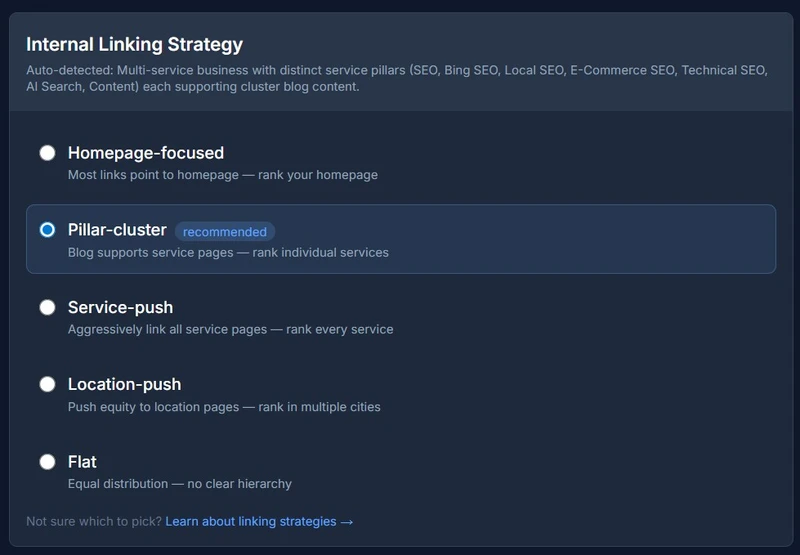
Strategies
Homepage-Focused
Best for: Single-service businesses, exact-match domains, local SEO where the homepage IS the money page.
How it works
- •Blog posts link to homepage using the primary keyword as anchor text
- •Service pages include a contextual link back to homepage
- •Location pages link to homepage + services
Example: A single-location plumber in Dallas wanting to rank for "plumber dallas".
Pros
- +Concentrates all link equity on your most important page
- +Great for exact-match or branded domains
- +Simple and effective for single-service businesses
Cons
- –Individual service pages get less direct link juice
- –Not ideal if you have many services targeting different keywords
Pillar-Cluster (Default)
Best for: Multi-service businesses wanting to rank each service page for its own keyword.
How it works
- •Blog posts link UP to their related service/pillar page (mandatory)
- •Service pages link to blogs conservatively (only objection-handling content)
- •Location pages link to all relevant services
Example: An HVAC company with separate pages for AC repair, installation, and maintenance.
Pros
- +Distributes authority across all service pages
- +Each service page builds topical authority through its blog cluster
- +Balanced default that works for most businesses
Cons
- –Homepage gets equity only from navigation (no in-content push)
- –Requires enough blog posts to support each pillar
Service-Push
Best for: Multi-service businesses in competitive niches where every service page needs to rank.
How it works
- •Blog posts link to ALL services mentioned (not just their parent)
- •Service pages cross-link to related services
- •Homepage includes in-content links to top 3-5 services
Example: A law firm with 10 practice areas, each targeting high-value keywords.
Pros
- +Maximizes link equity to service pages from all directions
- +Service cross-linking builds topical clusters
- +Great for competitive multi-service niches
Cons
- –More aggressive linking may feel less natural
- –Location pages receive less direct equity
Location-Push
Best for: Multi-location businesses competing for "[service] in [city]" across many areas.
How it works
- •Service pages link to ALL locations where they operate
- •Blog posts link to location pages when geographically relevant
- •Location pages aggressively cross-link to nearby locations
Example: An HVAC company serving 15 suburbs that wants each location page to rank.
Pros
- +Pushes equity to location pages for local pack/map rankings
- +Location cross-linking builds geographic relevance signals
- +Great for franchise or multi-area service businesses
Cons
- –Individual service pages may get less equity
- –Only effective if you have location pages to link to
Flat
Best for: Informational sites, SaaS businesses, or any site with no clear "money page" hierarchy.
All pages link to any relevant page equally (max 5 per page)
How it works
- •Every page links to contextually relevant pages regardless of type
- •No page type gets preferential equity
- •Maximum 5 internal links per page to prevent dilution
Example: A SaaS documentation site or a general blog without conversion-focused service pages.
Pros
- +Simple and natural linking pattern
- +Good for sites where all pages have equal importance
- +No risk of over-optimizing link flow
Cons
- –No targeted equity concentration on money pages
- –Not ideal for businesses with clear conversion pages
Which Strategy Should I Choose?
| Your Situation | Recommended Strategy |
|---|---|
| I want to rank my homepage for "[service] [city]" | Homepage-Focused |
| I have multiple services, each targeting different keywords | Pillar-Cluster or Service-Push |
| I serve many locations and want each to rank | Location-Push |
| I have one main service and one location | Homepage-Focused |
| My site is informational / SaaS / no clear money page | Flat |
| I'm not sure | Pillar-Cluster (safe default) |
Can I Change Later?
Yes. You can select a different strategy during the structure review step before your website generates. If your site has already been generated and you want to change the linking topology, you can use the AI coding assistant tool to make modifications.